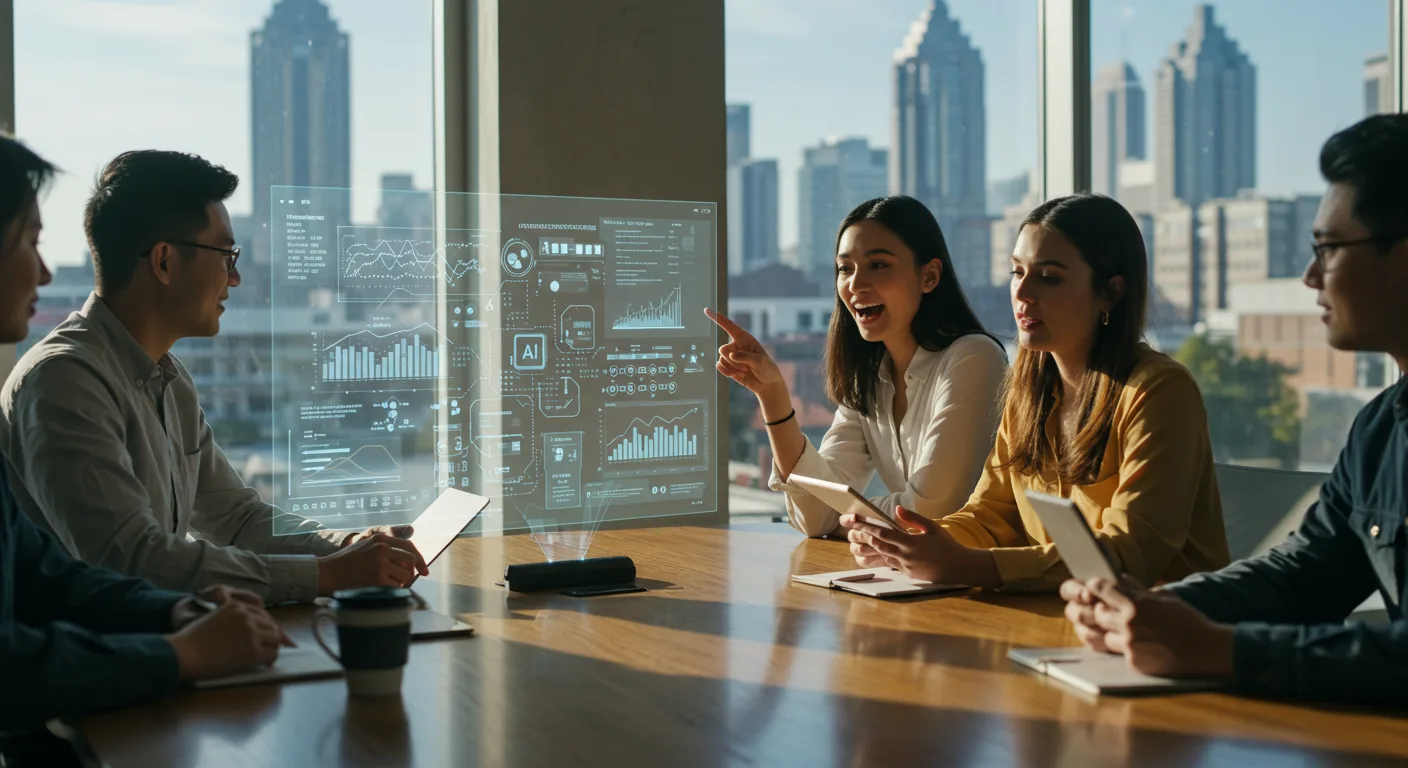
Are you tired of staring blankly at your screen, waiting for that spark of creative inspiration to ignite your next marketing campaign? The old ways of brainstorming just aren’t cutting it anymore. What if I told you that by 2026, AI will be your most valuable creative partner, not your replacement?
Key Takeaways
- By late 2026, AI-powered “inspiration hubs” will generate personalized content briefs based on real-time trend analysis and competitor activity.
- Interactive AI tools will allow marketers to co-create visual assets, writing copy variations, and even A/B test entire campaign concepts in a matter of hours.
- Instead of replacing human creativity, AI will free up marketers to focus on strategic thinking, brand storytelling, and building authentic customer relationships.
The Inspiration Drought: A Problem We All Know
Let’s face it: generating fresh, innovative ideas consistently is a huge challenge. Marketing teams in Atlanta, from Midtown startups to the big agencies down in Buckhead, are all feeling the pressure. We’re expected to pump out engaging content, clever ad campaigns, and viral social media posts, all while juggling tight budgets and even tighter deadlines. And the worst part? The methods we’ve relied on for years – traditional brainstorming sessions, competitor analysis, and even those “creative retreats” up in the North Georgia mountains – are often yielding diminishing returns.
I remember a campaign we launched for a local Decatur brewery back in 2023. We spent weeks in meetings, throwing ideas at the wall, only to end up with a concept that felt… generic. It wasn’t bad, per se, but it lacked that special something that would truly resonate with their target audience. Sales were okay, but nothing spectacular. The client was happy enough, but we knew we could have done better.
What Went Wrong First: The Failed Approaches
Before AI started gaining serious traction, we tried a few different approaches to combat this creative block. One was outsourcing content creation to freelance platforms. While this provided a steady stream of articles and social media posts, the quality was often inconsistent, and the content rarely captured the unique voice and personality of our clients. Another approach was investing in more sophisticated analytics tools. We hoped that by diving deeper into customer data, we could uncover hidden insights that would spark new ideas. However, this often led to “analysis paralysis,” where we were so overwhelmed with data that we struggled to extract any meaningful conclusions. We even tried those expensive “ideation workshops” that promised to unlock our team’s creative potential. The result? A lot of Post-it notes and very few actionable ideas. Here’s what nobody tells you: creativity can’t be forced.
The AI Revolution: A New Dawn for Creative Inspiration
Now, in 2026, the game has changed. Artificial intelligence has emerged as a powerful tool for creative inspiration in the marketing world. It’s not about replacing human creativity, but about augmenting it, amplifying it, and freeing us from the mundane tasks that stifle innovation. The key is using AI strategically, as a partner in the creative process, not a substitute for it.
Step 1: The AI-Powered Inspiration Hub
Imagine a centralized platform that constantly monitors real-time trends, analyzes competitor activity, and identifies emerging customer needs. That’s the power of the AI-powered “inspiration hub.” Platforms like Adobe Creative Cloud and Canva are already integrating these features, providing marketers with a constant stream of fresh ideas and insights. These hubs use machine learning algorithms to analyze vast amounts of data, identifying patterns and connections that humans might miss. For example, if you’re developing a campaign for a new restaurant in the West Midtown neighborhood, the AI could identify trending food hashtags, popular local events, and the most effective marketing messages used by similar restaurants in the area. This information is then used to generate personalized content briefs, providing you with a solid foundation for your creative work.
Step 2: Interactive Co-Creation with AI
Once you have a content brief, the real fun begins. Interactive AI tools allow you to co-create visual assets, write copy variations, and even A/B test entire campaign concepts in a matter of hours. Let’s say you’re working on a social media campaign for a new line of athletic apparel. Instead of spending days brainstorming different visual concepts, you can use an AI image generator to create dozens of variations based on your initial ideas. You can then refine these images, experiment with different color palettes, and even generate realistic models wearing the apparel. Similarly, AI-powered copywriting tools can help you craft compelling ad copy, website content, and social media posts. These tools can generate multiple variations of your copy, tailored to different audiences and platforms. And the best part? You can A/B test these variations in real-time, using AI to optimize your messaging for maximum impact.
Step 3: Strategic Thinking and Authentic Storytelling
With AI handling the more repetitive and time-consuming aspects of the creative process, marketers are free to focus on what they do best: strategic thinking, brand storytelling, and building authentic customer relationships. Instead of spending hours crafting individual social media posts, you can focus on developing a cohesive brand narrative that resonates with your target audience. Instead of getting bogged down in the details of ad campaign optimization, you can focus on understanding your customers’ needs and developing creative solutions that meet those needs. This shift in focus allows marketers to be more strategic, more creative, and more effective.
Case Study: Revitalizing a Local Bakery with AI
Last year, we worked with a struggling bakery in Little Five Points. They were facing declining sales and struggling to attract new customers. We implemented an AI-driven marketing strategy to revitalize their brand. First, we used an AI-powered trend analysis tool to identify emerging food trends in Atlanta. The AI identified a growing interest in vegan and gluten-free baked goods. Based on this insight, we developed a new line of vegan and gluten-free products. Next, we used an AI image generator to create stunning visuals of these new products. We then used an AI copywriting tool to craft compelling social media posts and ad copy. We A/B tested different variations of our ads, using AI to optimize our messaging for maximum impact. Within three months, the bakery’s sales increased by 30%, and their social media engagement skyrocketed. The key? We didn’t just blindly follow the AI’s suggestions. We used our own creativity and expertise to refine the AI’s output and ensure that it aligned with the bakery’s brand identity.
This mirrors what we’ve seen with other video ads that get bakery customers: targeted content is key.
The Future is Collaborative, Not Competitive
The future of creative inspiration isn’t about humans versus machines. It’s about humans and machines working together to create something truly special. AI can provide us with the raw materials, the insights, and the tools we need to be more creative. But it’s up to us to provide the vision, the strategy, and the human touch that makes marketing truly effective. According to a recent IAB report, marketers who embrace AI-powered creative tools are 25% more likely to report exceeding their revenue goals. Furthermore, eMarketer projects that AI spending in the marketing sector will reach $52 billion by 2028, signaling a massive shift in how we approach creative work.
Now, there are limitations. AI can sometimes produce generic or even nonsensical results if not properly guided. It’s essential to train the AI on your brand’s unique voice and style, and to always review the AI’s output critically. Think of it as an intern – a very powerful intern, but an intern nonetheless. It needs guidance and oversight. And yes, there’s the ethical question of AI-generated content and the potential for plagiarism. It’s crucial to use AI responsibly and ethically, ensuring that all content is original and properly attributed. But let’s be honest, these are challenges we can overcome. The potential benefits of AI-powered creative inspiration far outweigh the risks.
Preparing for the AI-Powered Future
So, how can you prepare for this AI-powered future? Start by experimenting with different AI tools and platforms. Explore the features of Meta Business Suite‘s AI-powered ad creation tools. Play around with AI image generators like Midjourney. And don’t be afraid to fail. The key is to learn from your mistakes and to continuously refine your approach. Second, invest in training for your marketing team. Teach them how to use AI tools effectively and how to integrate AI into their creative workflows. And finally, embrace a culture of experimentation and innovation. Encourage your team to try new things, to take risks, and to push the boundaries of what’s possible. The future of creative inspiration is here. Are you ready to embrace it?
Want to dominate your niche? It might be time to dominate LinkedIn, marketing’s 2026 edge.
Will AI replace human marketers entirely?
No. AI is a tool to augment human creativity, not replace it. The strategic thinking, emotional intelligence, and brand storytelling that humans bring to the table will remain essential.
How can I ensure that AI-generated content aligns with my brand’s voice and style?
Train the AI on your existing content, providing it with examples of your brand’s unique tone and messaging. Review the AI’s output critically and refine it to ensure that it aligns with your brand guidelines.
What are the ethical considerations of using AI-generated content?
Ensure that all AI-generated content is original and properly attributed. Avoid using AI to create deceptive or misleading content. Be transparent with your audience about the use of AI in your marketing efforts.
How much does it cost to implement an AI-powered marketing strategy?
The cost varies depending on the specific tools and platforms you choose. Some AI tools are free or offer free trials, while others require a subscription. The cost of training and implementation should also be factored in.
What are the biggest challenges of using AI for creative inspiration?
The biggest challenges include ensuring the quality and originality of AI-generated content, maintaining brand consistency, and addressing ethical concerns. It’s also important to avoid becoming overly reliant on AI and to retain a human-centered approach to marketing.
Don’t wait for the perfect moment. Start small. Pick one AI tool, maybe one that helps generate social media captions, and dedicate just 30 minutes a day to experimenting with it. The future of marketing hinges on your ability to adapt and integrate these technologies. The time to start is now.



