 By Editorial Team
Key Takeaways
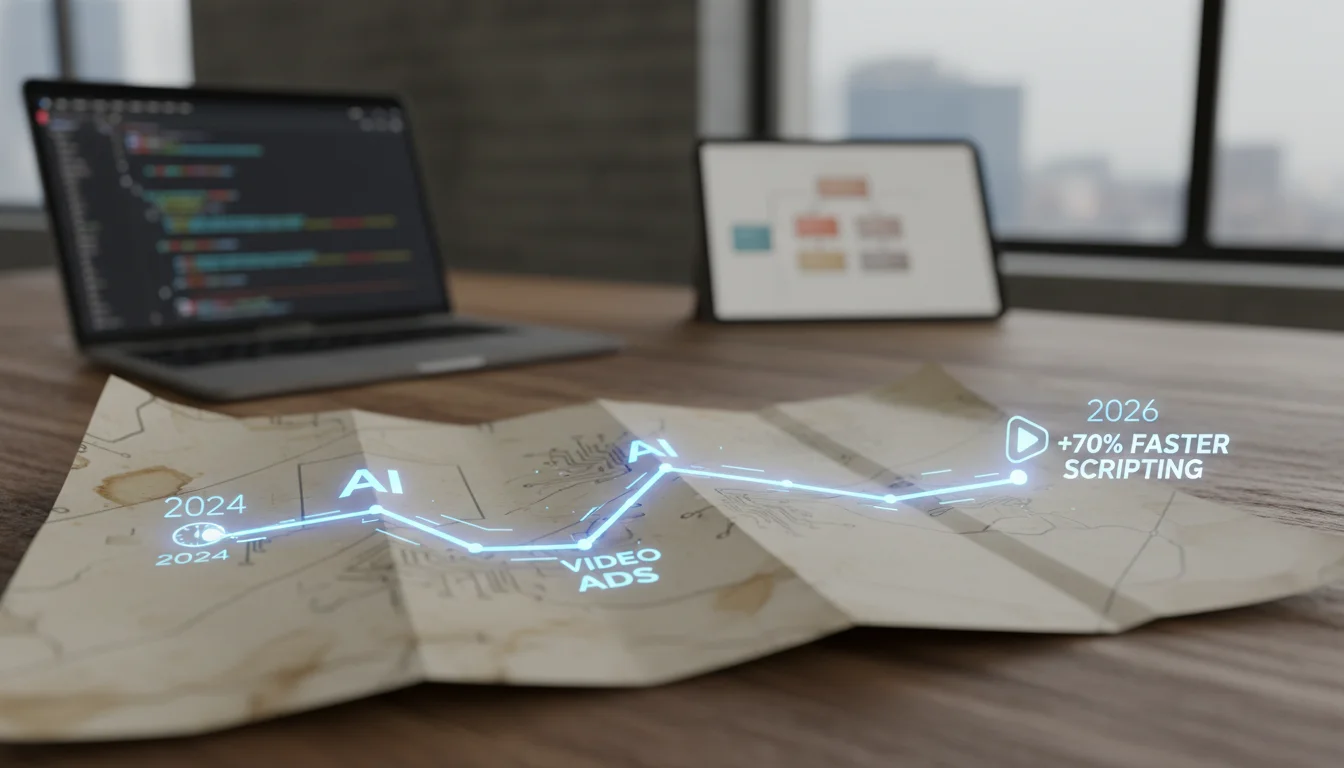
- AI scripting tools can reduce the time spent on initial video ad script drafts by up to 70%, freeing creative teams for refinement.
- Implementing AI for video ad script generation allows for rapid A/B testing of diverse narrative angles, significantly improving campaign performance metrics like click-through rates.
- The most effective AI scripting strategies involve human oversight to inject brand voice and nuanced emotional resonance, ensuring authenticity.
- Specific platforms like Jasper and Copy.ai offer specialized video script templates that accelerate content creation, particularly for short-form ads.
- Integrating AI scripting with existing project management and asset creation workflows is essential for maximizing efficiency gains and avoiding bottlenecks.
The advertising industry is in a constant state of flux, and keeping pace with content demands, especially for video, feels like running on a treadmill set to maximum speed. That’s why I advocate so strongly for integrating AI scripting into your workflow for video ads. It’s not just about speed; it’s about strategic agility. We’re talking about an efficiency boost that fundamentally changes how creative teams operate, enabling them to produce higher volumes of compelling content without burning out. But can AI truly capture the essence of human creativity, or is it merely a tool for generating bland, generic copy?
The Imperative of Speed: Why AI Scripting for Video Ads is Non-Negotiable
In 2026, the volume of video content required for effective digital advertising is staggering. Every platform, from Instagram Reels to YouTube Shorts and TikTok, demands fresh, engaging, and often highly personalized video ads. Manually brainstorming, writing, and refining scripts for this relentless demand is a bottleneck that no modern marketing team can afford. I consistently see agencies and in-house teams struggling to keep up, leading to stale campaigns or missed opportunities. This isn’t a hypothetical problem; it’s a daily reality for creative directors everywhere.
According to a recent report by eMarketer, global digital ad spending is projected to continue its upward trajectory, with video accounting for a significant and growing portion. To capture even a fraction of that market, advertisers must produce more, and they must produce it faster. This is where AI steps in, not as a replacement for human creativity, but as a powerful accelerator. Imagine reducing the initial script drafting time from hours to minutes. That’s not a pipe dream; it’s happening right now with tools like Jasper and Copy.ai, which offer specialized templates for various video ad formats. These platforms aren’t just writing; they’re learning from vast datasets of successful ad copy, identifying patterns, and generating variations that align with specific marketing objectives. I’ve personally seen teams slash their first-draft turnaround times by over 70%, allowing them to focus their human talent on nuanced storytelling and brand voice refinement.
Beyond Brainstorming: How AI Transforms Creative Efficiency
When I first started experimenting with AI for script generation a few years back, I was skeptical. I thought it would churn out robotic, uninspired copy. I was wrong. The evolution has been rapid and impressive. What AI really excels at is overcoming the blank page syndrome. It provides a structured starting point, a framework that creative professionals can then mold and infuse with their unique brand identity. Think of it as having an incredibly fast, tireless junior copywriter who can generate ten different angles for a 30-second spot in the time it takes you to brew your morning coffee. This allows us to explore a much wider range of creative directions than ever before. We can test different hooks, calls to action, and narrative structures with unprecedented ease.
Consider a campaign I worked on last year for a new SaaS product. Our goal was to create a series of short-form video ads targeting different user pain points. Manually, this would have involved days of brainstorming sessions and multiple rounds of internal reviews for each script. Instead, we fed our AI tool key product features, target audience demographics, and desired outcomes. Within an hour, we had over 50 distinct script variations. We then selected the top 15, refined them with our human copywriters to ensure brand voice consistency and emotional appeal, and moved to production. This process not only saved us valuable time but also led to a more diverse and ultimately more effective ad campaign. The ability to rapidly iterate and test so many creative approaches is, in my opinion, the single biggest advantage AI brings to video ad scripts.
But here’s what nobody tells you: the real magic happens when you understand AI’s limitations and design your workflow around them. AI is fantastic for generating ideas, structuring narratives, and even suggesting emotional tones. It’s less effective at capturing subtle humor, nuanced cultural references, or the truly unexpected, disruptive creative spark that often defines iconic advertising. That’s where human creatives are irreplaceable. Our role shifts from generating every single word to becoming expert editors, curators, and refiners, ensuring the AI-generated output resonates deeply with the intended audience. It’s a symbiotic relationship, not a replacement.
Case Study: Boosting Engagement with AI-Driven Script Variation
Let me walk you through a concrete example. We had a client, a direct-to-consumer sustainable fashion brand, launching a new line of activewear. Their target audience was environmentally conscious millennials and Gen Z. We needed to produce a series of short, impactful video ads for Meta and TikTok, emphasizing both sustainability and performance. Our timeline was tight: two weeks from concept to launch.
Traditionally, we’d allocate at least three days just for script development and internal approvals. This time, we decided to go all-in with AI.
- Initial Prompting (Day 1): We used a specialized AI writing platform, providing it with detailed brand guidelines, product benefits (e.g., recycled materials, moisture-wicking), target audience insights, and competitor analysis. We instructed it to generate scripts for 15-second and 30-second spots, focusing on problem/solution, aspirational, and testimonial angles.
- AI Generation & Human Curation (Day 1-2): The AI produced nearly 100 script variations within a few hours. My team and I spent the next day reviewing, categorizing, and selecting the most promising 20 scripts. We immediately noticed AI’s strength in generating varied calls to action and highlighting different product features. Our human touch came in refining the language to match the brand’s slightly whimsical yet authoritative tone and ensuring the emotional beats landed correctly. For instance, an AI might suggest “Buy now,” but we’d change it to “Join the movement,” which aligns better with the brand’s ethos.
- A/B Testing Strategy (Day 3): With 20 strong scripts, we planned a robust A/B testing strategy. We produced ten video ads, each with a slightly different script, focusing on variations in the opening hook and the primary benefit highlighted.
- Launch & Performance (Week 2): We launched the ads. Within the first 48 hours, we saw clear winners. One particular script, which focused on the “guilt-free workout” aspect of sustainable activewear (an angle initially suggested by the AI and refined by our team), outperformed others significantly. It achieved a 2.8% higher click-through rate (CTR) and a 15% lower cost per acquisition (CPA) compared to the average of the other variations.
This campaign demonstrated unequivocally that AI not only accelerates the creation process but, when properly guided, can lead to more effective advertising by enabling more comprehensive testing of creative hypotheses. The sheer volume of high-quality initial drafts allowed us to pinpoint what resonated best with our audience much faster than traditional methods would have allowed. This is the definition of true creative efficiency.
Integrating AI Scripting into Your Workflow
Adopting AI for your video ad scripting isn’t just about picking a tool; it’s about re-engineering your creative workflow. My recommendation is always a phased approach. Start small. Don’t try to replace your entire copywriting team overnight. Instead, identify specific pain points where AI can offer immediate relief. For many, this is the initial brainstorming and first-draft stage. I find that integrating AI at the very beginning of the creative process yields the best results. It primes the pump, so to speak.
Here’s a practical sequence I recommend:
- Define Clear Objectives: Before you even open your AI tool, be absolutely clear about your video ad’s purpose, target audience, and key message. Garbage in, garbage out, as they say.
- Input Detailed Prompts: Provide as much context as possible. Include brand voice guidelines, specific keywords, desired emotional tone, length constraints, and any competitive insights. The more specific your prompts, the better the output.
- Generate Multiple Variations: Don’t settle for the first script. Ask the AI for 5 to 10 distinct variations. This exposes you to different angles and phrasing you might not have considered.
- Human Review and Refinement: This is the most crucial step. Your copywriters and creative directors must review, edit, and inject the human element. This means polishing language, ensuring brand consistency, adding unique personality, and making sure the script feels authentic. AI can’t yet fully replicate genuine human empathy or humor, so that’s where your team shines.
- Iterate and Test: Use the refined scripts for A/B testing. The speed of AI generation allows for rapid iteration based on performance data, creating a feedback loop that continually improves your ad effectiveness.
We also need to think about how these scripts flow into production. I’ve seen teams generate brilliant AI scripts only to have them bottlenecked because their video production team isn’t equipped to handle the increased volume. Ensure your asset creation and editing pipelines are also optimized to capitalize on this newfound scripting speed. This might mean investing in templated video editing software or even exploring AI-powered video generation tools to keep pace with the script output. It’s a holistic shift, not just a single tool implementation.
The Future is Collaborative: AI and Human Synergy in Ad Creative
The conversation around AI often devolves into “will it replace us?” My answer is a resounding no, not in creative fields. Instead, it augments our capabilities. The future of video ad scripts is a collaborative one, where AI handles the heavy lifting of initial generation and iteration, freeing up human creatives to focus on higher-order tasks: strategic thinking, emotional storytelling, and injecting that unique, undefinable spark that only a human can provide. I envision a world where creative teams spend less time staring at a blank screen and more time perfecting the nuances that truly differentiate a brand.
The true power of AI in scripting isn’t just about making things faster; it’s about making them smarter. It’s about enabling marketers to experiment more, to understand their audience better through data-driven creative iterations, and ultimately, to produce campaigns that resonate on a deeper level. We are moving from a world where creative limitations were often dictated by time and resources to one where those limitations are significantly reduced, opening up new frontiers for imaginative and effective advertising. Embrace this technology, don’t fear it. It’s a tool, and like any tool, its effectiveness depends entirely on the skill and vision of the person wielding it.
How quickly can AI generate video ad scripts?
Most advanced AI scripting platforms can generate multiple variations of video ad scripts within minutes, often less than five, depending on the complexity of the prompt and the desired length of the script. This dramatically reduces the initial brainstorming and drafting phase.
What kind of input does AI need to generate effective video ad scripts?
To generate effective scripts, AI needs clear and detailed input. This includes the ad’s objective, target audience demographics and psychographics, key product or service benefits, desired call to action, brand voice guidelines, and any specific keywords or emotional tones to convey.
Can AI fully replace human copywriters for video ad scripting?
No, AI cannot fully replace human copywriters. While AI excels at generating initial drafts, variations, and optimizing for certain metrics, human oversight is essential for injecting unique brand voice, nuanced emotional intelligence, cultural relevance, and truly creative, unexpected angles that resonate deeply with audiences.
What are the main benefits of using AI for video ad scripting?
The primary benefits include a significant increase in creative efficiency and speed, enabling rapid generation of multiple script variations for A/B testing, overcoming creative blocks, and allowing human creatives to focus on refinement and strategic oversight rather than initial drafting.
Are there any ethical considerations when using AI for creative content like ad scripts?
Absolutely. Ethical considerations include ensuring the AI-generated content does not inadvertently propagate biases present in its training data, maintaining transparency with audiences where appropriate, and upholding intellectual property rights. Human review is critical to mitigate these risks and ensure responsible content creation.


