 By Editorial Team
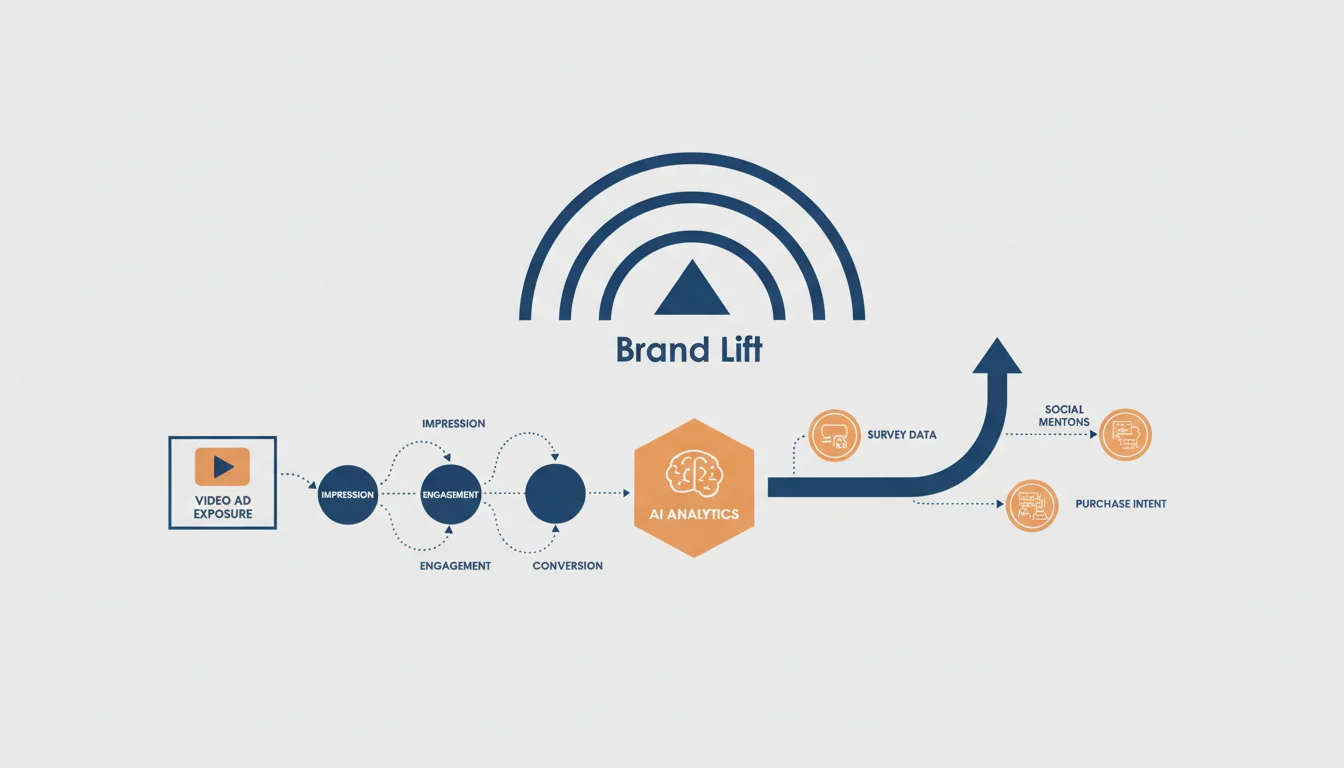
Trying to prove video ad impact with last-click attribution is like trying to see in the dark. It gives you a sliver of the picture, and it’s usually the wrong one. Now we have brand lift AI, which is finally letting us see how our campaigns change what people think about a brand, going way past simple conversions. The real question is, how do you actually put these new attribution models to work and prove your video ads are doing their job?
Key Takeaways
- You need a control group in your brand lift studies. Make it at least 10% of your sample, or your results won’t be statistically sound.
- Use the built-in AI tools on the platforms themselves, like Google’s Brand Lift Solution or Meta’s Brand Lift Measurement, for easy survey deployment and number-crunching.
- Plug your first-party CRM data into your brand lift results. This is how you connect brand perception to high-value customers.
- Track at least three core metrics: ad recall, brand awareness, and consideration. A 3-5% lift is the target for a campaign that’s actually working.
- Use the AI’s findings to constantly tweak your creative, especially the first five seconds of your video ads where brand association is made or broken.
1. Establish a Strong Control Group Methodology
Any brand lift study you run, especially one using AI, is completely worthless without a solid control group. Otherwise, you’re just tracking correlation, not proving that your ads caused a change. My process is always the same: split your audience into an exposed group (they see the ads) and a control group (they don’t). On platforms like Google Ads, the Brand Lift Solution automates this with a randomized holdback. But if you’re running on multiple channels or using your own surveys, you’ve got to manage the groups yourself.
You need to be strict about the numbers. Your control group should be at least 10% to 15% of your total audience to get statistically significant results. For a recent B2B SaaS client, we were targeting enterprise decision-makers and set aside a 12% control group across both LinkedIn and YouTube. This gave us the confidence to report a 7% lift in brand favorability from our video series, a number we couldn’t have defended without that clean baseline. No ad exposure for the control. Period. Not even accidental retargeting.
Pro Tip: Use Sequential Exposure for Deeper Insights
If you have the budget, add a third group for sequential exposure. Show them a lighter version of the campaign or a different creative before they see the main video ad. This lets the AI models tell you the incremental impact of a specific ad or how many times someone needs to see it, giving you far more detailed insights than a simple exposed vs. control setup.
Common Mistake: Insufficient Control Group Size
The classic mistake is making the control group too small, like under 5%, because you want more reach. Don’t do it. You’ll end up with noisy data and statistically insignificant results, which means you can’t make any real conclusions about your video ad’s influence. A strong control group is always the priority, even if it shaves a bit off your immediate audience size.
2. Deploy Platform-Native Brand Lift Surveys
The big ad platforms all have their own brand lift survey tools now, and they’re pretty good. Google’s Brand Lift Solution and Meta’s Brand Lift Measurement are the ones I use constantly for video campaigns. They’re powered by the platform’s own AI to figure out when to show the survey questions and how to analyze the answers. These tools automatically fire short, in-stream surveys to people in your exposed and control groups, asking about ad recall, awareness, consideration, and purchase intent.
Your questions have to be precise. Don’t ask a lazy question like, “Are you aware of Brand X?” Instead, ask, “Which of these brands have you heard of recently?” and list your brand among a few competitors. For recall, I like to ask, “Which of the following brands have you seen an ad for in the last 2 days?” (using a tight timeframe is key). The platform’s AI then crunches the numbers, compares the percentage of positive responses from the exposed group to the control group, and spits out the lift your video ad generated.
Setting this up in Google Ads is straightforward: go to “Measurement,” then “Brand Lift,” and start a new study. You’ll link it to your campaign, pick your metrics (I always pick at least awareness, recall, and consideration), and write your questions. The AI handles the rest, collecting data without ruining the user experience. The report will show you the exact percentage lift for each metric, and you can often slice it by audience or creative to see which of your video ads are pulling their weight.
3. Integrate First-Party Data for Enriched Attribution
While the platform tools are good, real attribution in 2026 happens when you connect them to your own first-party data. This is where the AI really starts to cook, linking survey responses about brand perception to what your customers actually do. You need to upload your CRM data, customer lists, purchase history, lifetime value (LTV), into a platform like Google Analytics 4 or a CDP like Segment, and then connect that to your brand lift survey data.
The system then matches users anonymously. For instance, the AI can see that a user in your exposed group showed a big jump in “brand consideration” and then, a week later, they actually bought something. It starts to find patterns. What are the common traits of people who have a high brand lift and then become your best customers? Are they a specific demographic? Do they work at a certain type of company? This lets you stop guessing and start building your targeting and creative around the audiences that are most likely to be influenced by your brand ads.
Pro Tip: Create Lookalike Audiences from High-Lift Segments
Once the AI identifies the profile of users who showed high brand lift and then converted, use that profile to build a lookalike audience. This is a powerful way to scale your campaigns and find new people who are predisposed to like your brand, giving you a much higher probability of success.
Common Mistake: Data Silos Preventing Well-rounded Analysis
So many companies have their data all over the place. The brand lift numbers are in the ad platform, the CRM data is with the sales team, and the web analytics are somewhere else entirely. If the data isn’t unified, the AI can’t connect the dots, and you miss huge opportunities. You have to invest in a way to bring it all together.
4. Use AI for Creative Optimization and Predictive Analytics
The point of using AI for brand lift isn’t just getting a report card on your campaign. It’s about making smarter creative choices next time. AI tools can break down your video ads, analyzing pacing, emotional tone, text overlays, even shot changes, and find correlations with your brand lift results. For example, the AI might find that your video ads that show a product demo within the first 10 seconds get a 4% higher ad recall than your ads that start with a story.
You can use tools like Google Cloud Vision AI to analyze your video files on a very deep level. Upload your creatives, and the AI will tag objects, read sentiment, and analyze expressions. When you cross-reference that analysis with your brand lift data, you get a clear picture of what visual and narrative elements actually move the needle on brand perception. For a financial services client, our AI analysis showed that videos with testimonials from different types of customers got a 6% higher consideration lift than our animated explainer videos did. That single insight changed our entire production plan for the next quarter.
Better yet, AI can start to predict how new ads will perform. After you feed it enough historical data on your video elements and their brand lift results, it can give you a forecast for a new creative before you even spend a dollar running it. This cuts down on wasted time and money in creative testing.
5. Establish Clear Brand Lift Benchmarks and Iterative Testing
Brand lift measurement is an ongoing process of testing and learning. You need to set clear benchmarks for success from the start. For most of my campaigns, a 3% to 5% lift in a key metric like ad recall or awareness is solid, and anything over 5% is fantastic. Of course, these numbers change based on your industry and audience, so do some homework with reports from the IAB or eMarketer to set realistic goals.
With benchmarks in place, you need an iterative testing plan. This just means you’re always A/B testing something about your video ads, the creative, the targeting, the placement, and measuring the brand lift for each version. Test a video that opens with a strong call-to-action against one with a slower, narrative opening. The AI will tell you which one drove a higher lift in consideration. A consumer electronics client of mine found that simply adding product feature overlays in the first 15 seconds of their YouTube ads gave them a 4.2% higher brand awareness lift. That one finding completely reshaped their video strategy.
This feedback loop, driven by the AI’s ability to crunch the numbers, is how you systematically improve your video ad spend for brand impact. The brands that are winning in 2026 are the ones constantly adapting their message based on granular, AI-driven data about how their audience really sees them.
Using AI for brand lift is no longer a futuristic idea. It’s a practical requirement for any marketer who wants to know if their video ads are actually working. By setting up proper control groups, using the platform-native tools, connecting your first-party data, and letting AI guide your creative, you can move your brand strategy from guesswork to a precise, data-driven operation where every video ad dollar contributes to real brand growth.
What is brand lift AI?
It’s using artificial intelligence to measure how your ad campaigns, especially video, actually change what people think about your brand. The AI analyzes survey data from people who saw your ads versus those who didn’t to measure the impact on metrics like brand awareness, recall, and consideration.
How does AI improve traditional brand lift studies?
AI makes brand lift studies faster and smarter. It can find patterns in the data that a human would miss, like which specific parts of a video ad lead to a bigger lift. It can also help predict how well a new ad might perform and connect survey results to your actual sales data from your CRM for a much fuller picture.
What are the key brand metrics to track with brand lift AI?
The big ones are ad recall (do they remember seeing your ad?), brand awareness (do they know your brand exists?), and consideration (would they consider buying from you?). You can also track favorability (do they have a positive feeling about your brand?) and purchase intent (are they planning to buy?).
Can brand lift AI help optimize video ad creatives?
Absolutely. This is one of its most powerful uses. AI can analyze things like pacing, music, and specific visuals in your video and tell you which elements are driving the best results. This gives you concrete, data-backed feedback to make your next round of ads even better, enabling true data-driven creative work.
What is a good brand lift percentage to aim for?
It really depends on your industry and goals, but as a general rule, a 3% to 5% lift in a key metric like ad recall or awareness is a strong result that shows your campaign is effective. If you’re seeing a lift over 5%, that’s an excellent outcome and means your message and targeting are really hitting the mark.


