 By Ashley Lewis
Key Takeaways
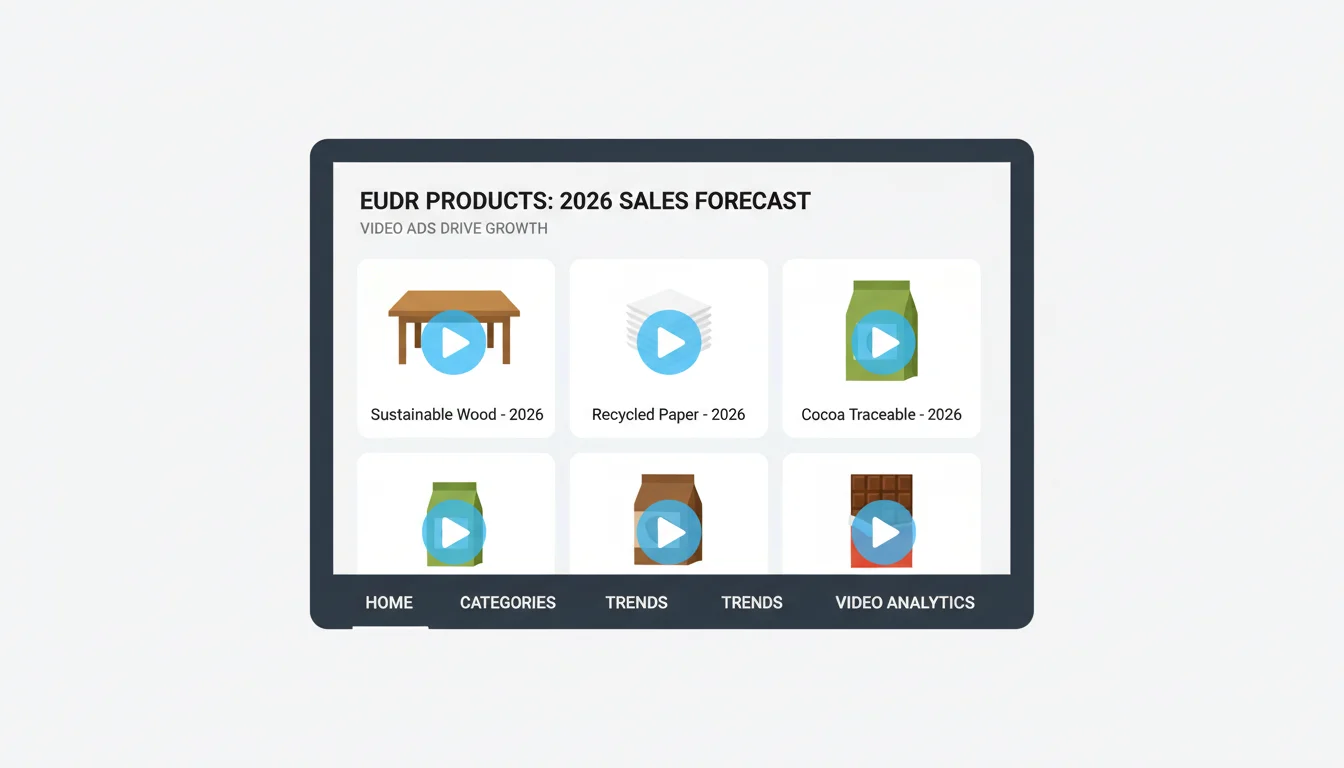
- Businesses launching new EUDR products must integrate video advertising early into their go-to-market strategy to effectively communicate complex compliance and sustainability narratives.
- Allocate at least 30% of your initial marketing budget for new EUDR-compliant product lines specifically to video ads, focusing on platforms like Google’s Performance Max and Meta’s Advantage+ Creative for broad reach.
- Develop a multi-stage video content strategy that includes short-form explainers for awareness, longer-form narratives for education, and user-generated content (UGC) for trust-building, tailored to different stages of the customer journey.
- Prioritize clear, verifiable sustainability claims in all video creative, backing them with transparent data and certifications, to resonate with environmentally conscious consumers and avoid greenwashing accusations.
- Implement granular tracking and A/B testing for all video campaigns, monitoring metrics beyond simple views to include engagement rates, conversion assists, and brand sentiment specific to sustainability messaging.
The year is 2026, and the European Union Deforestation Regulation (EUDR) has fundamentally reshaped global supply chains, forcing companies to prove their products are deforestation-free. This regulatory earthquake has triggered a significant market shift, especially for brands introducing new, compliant product lines. For many, the challenge isn’t just compliance, but effectively communicating that compliance to consumers. How do you cut through the noise and explain something as intricate as supply chain traceability in a compelling way? For Sarah Chen, Head of Marketing at “VerdeHome,” a burgeoning sustainable furniture brand based out of Atlanta, Georgia, the answer lay squarely in the power of video ads. Sarah’s mandate was clear: launch VerdeHome’s new line of EUDR-certified oak dining tables and chairs, sourced exclusively from sustainably managed forests in the Baltic region, by Q3 2026. The furniture itself was beautiful, handcrafted in a workshop off I-75 near the Atlanta BeltLine, but the real story was its provenance. “We spent two years re-engineering our entire supply chain,” Sarah explained during our initial strategy session at a coffee shop in Midtown. “From satellite monitoring of forest plots to blockchain-verified timber shipments, we have the receipts. But how do we tell that story in a way that doesn’t sound like a white paper?” This was the core dilemma facing countless businesses: how to transform complex, often dry, compliance data into an engaging consumer narrative.
The Initial Hurdle: Translating Complexity into Consumer Value
VerdeHome’s initial marketing plans for the new EUDR line leaned heavily on traditional digital channels: display ads, search engine marketing, and detailed landing pages. However, early focus group feedback was sobering. Consumers, while increasingly aware of sustainability, found the detailed explanations of EUDR compliance dense and uninspiring. “It’s like reading a legal document,” one participant commented. “I get that it’s good, but I don’t feel it.” This was a critical insight. Simply stating “EUDR compliant” wasn’t enough. The ‘why’ and ‘how’ needed to be visceral. “Our first attempt at ad copy was a disaster,” Sarah admitted with a wry smile. “We were so focused on accuracy, we forgot about appeal.” The problem, as I saw it, wasn’t the information itself, but the medium. Text and static images struggle to convey the journey, the effort, and the tangible impact of sustainable sourcing. This is where video entered the conversation, not as an afterthought, but as the central pillar of their launch strategy.
Crafting the Visual Narrative: From Forest to Home
Our strategy pivoted to a multi-phase video campaign designed to educate, engage, and in the end convert. The goal was to tell VerdeHome’s story in a way that resonated emotionally, building trust around their EUDR claims. The first phase focused on awareness and education. We developed a series of short-form video ads, 15 to 30 seconds in length, optimized for platforms like Google’s Performance Max and Meta’s Advantage+ Creative. These videos used stunning visuals of the Baltic forests, juxtaposed with scenes of VerdeHome’s artisans crafting the furniture. A key element was a brief, animated overlay illustrating the blockchain traceability, simplifying a complex process into a digestible visual. “We showed the forest, then a QR code animating onto a log, then the furniture,” Sarah explained. “It was abstract enough not to be overly technical, but concrete enough to imply traceability.” One particularly effective ad featured a time-lapse of a sapling growing into a mature tree, followed by the smooth transition to a finished VerdeHome table. The voiceover was concise: “From responsibly managed forests, certified deforestation-free. VerdeHome: sustainable living, beautifully crafted.” According to a Statista report from early 2026, consumers were 85% more likely to purchase a product after watching a video about it, a figure that underscored our direction.
Deepening Engagement with Long-Form Content and Testimonials
As consumers moved further down the funnel, our video strategy evolved. We created longer-form video content, 60 to 90 seconds, hosted on VerdeHome’s website and distributed via YouTube advertising and targeted email campaigns. These videos delved deeper into the EUDR compliance process, featuring interviews with forest managers, supply chain experts, and VerdeHome’s own sourcing team. We filmed these segments on location, showing the careful care taken at every step. This wasn’t just about showing a product. It was about showing a philosophy. “We brought in third-party certifiers to speak on camera,” Sarah noted. “Their presence lent immediate credibility. It’s one thing for us to say we’re compliant. It’s another for an independent expert to explain why our process meets the strictest EU standards.” This kind of transparent, third-party validation in video format is invaluable. A 2025 IAB report on video advertising trends highlighted a 40% increase in consumer trust for brands that include expert testimonials in their video content, especially for products with complex value propositions. User-generated content (UGC) also played an important role. We launched a campaign encouraging customers to share videos of their VerdeHome furniture in their own living spaces, emphasizing how sustainable choices fit into their daily lives. We offered a small discount for submissions, and the response was overwhelming. These authentic, unpolished videos resonated powerfully, showing real people enjoying the tangible benefits of VerdeHome’s commitment. “Seeing a family gather around our EUDR-certified table, knowing the journey that wood took, that’s what connects,” Sarah observed. We then repurposed these UGC videos into shorter social media ads, using their organic feel for broader reach.
Overcoming Skepticism and Greenwashing Concerns
The biggest challenge in this new EUDR market environment isn’t just getting attention. It’s building genuine trust. Consumers are increasingly wary of “greenwashing,” where companies make unsubstantiated or misleading environmental claims. Video, while powerful, also carries the risk of amplifying those concerns if not executed with absolute transparency. “We made a deliberate choice to show, not just tell,” Sarah emphasized. “Instead of simply claiming ‘sustainable,’ we showed the actual forest, the certification documents, the people involved. We even included a brief shot of our internal audit dashboard.” This level of detail, presented visually, helped mitigate skepticism. We ensured all claims in the video ads were directly verifiable via a prominent link to a dedicated “Sustainability” section on VerdeHome’s website, which contained downloadable audit reports and certification details. My own experience with clients in this space confirms Sarah’s approach. You cannot afford to be vague. When you are marketing EUDR products, your video ads become your evidence. They must clearly and concisely communicate your commitment to deforestation-free supply chains. I’ve seen too many brands try to gloss over the specifics, only to face backlash. The audience is educated, and they demand proof.
Measuring Impact and Iterating for Success
VerdeHome tracked a range of metrics beyond simple video views. We focused on engagement rates (how long viewers watched, comments, shares), click-through rates to the sustainability pages, and importantly, conversion assists where video played a role in the customer journey. We also ran A/B tests on different video creatives, experimenting with varying lengths, voiceover styles, and calls to action. “The data clearly showed that videos featuring our artisans had higher completion rates than those focused solely on the technical aspects of EUDR,” Sarah shared. “However, the technical videos drove more traffic to our detailed sustainability reports. It was a balance.” This iterative process allowed them to refine their strategy, allocating budget to the most effective content types for each stage of the funnel. By Q4 2026, VerdeHome reported a 25% increase in website traffic to their EUDR product pages and a 15% uplift in conversion rates for the new line, directly attributable to the video advertising campaign. Their average customer review also frequently mentioned the transparency and authenticity conveyed through their videos. The EUDR market shift demands a new level of transparency and storytelling from brands. For VerdeHome, video advertising wasn’t just another channel. It was the essential tool for building trust and communicating the intricate, impactful story behind their deforestation-free products.
What is the European Union Deforestation Regulation (EUDR)?
The EUDR is a regulation enacted by the European Union to ensure that certain commodities and derived products placed on the EU market do not contribute to deforestation or forest degradation anywhere in the world. It requires companies to conduct due diligence to verify that their products are deforestation-free and produced in accordance with relevant laws of the country of production.
Why are video ads particularly effective for marketing EUDR products?
Video ads are effective for EUDR products because they can visually communicate complex supply chain stories, show verifiable evidence of sustainability, and evoke emotion in a way that text or static images cannot. They allow brands to demonstrate transparency, build trust, and differentiate themselves in a competitive market by showing the journey of their products from source to consumer.
What types of video content should brands create for EUDR-compliant products?
Brands should create a mix of video content, including short-form awareness videos for social media, longer-form educational videos explaining compliance processes and certifications, behind-the-scenes footage of sourcing and production, and user-generated content featuring customers. This multi-faceted approach addresses different stages of the customer journey and various consumer interests.
How can brands avoid accusations of greenwashing in their video ads for EUDR products?
To avoid greenwashing, brands must prioritize transparency and verifiable claims in their video ads. This means showing actual evidence, such as forest locations, certification documents, and expert testimonials. All claims should be backed by clear data and easily accessible reports on the company’s website, ensuring consumers can independently verify the sustainability statements.
What key metrics should brands track for video ad campaigns promoting EUDR products?
Beyond standard metrics like views and impressions, brands should track engagement rates (watch time, shares, comments), click-through rates to dedicated sustainability pages, conversion assists, and brand sentiment related to sustainability messaging. A/B testing different video creatives and calls to action will also provide valuable insights into what resonates most with the target audience.


