 By Editorial Team
Key Takeaways
- In-stream video ads, playing directly within video content, consistently deliver higher viewability rates, often exceeding 90%, due to their unavoidable nature.
- Out-stream video ads, appearing in non-video content environments like articles, offer greater scalability and lower cost-per-view metrics, making them ideal for broad reach campaigns.
- Marketers should analyze campaign objectives and target audience engagement patterns to determine the optimal balance between in-stream for completion rates and out-stream for cost-efficiency.
- Pre-roll ad formats, a type of in-stream, demonstrate the highest completion rates, with some platforms reporting averages above 70% for shorter ad durations.
- Effective out-stream strategies demand strong creative that captures attention quickly, as users can scroll past these units, unlike their embedded in-stream counterparts.
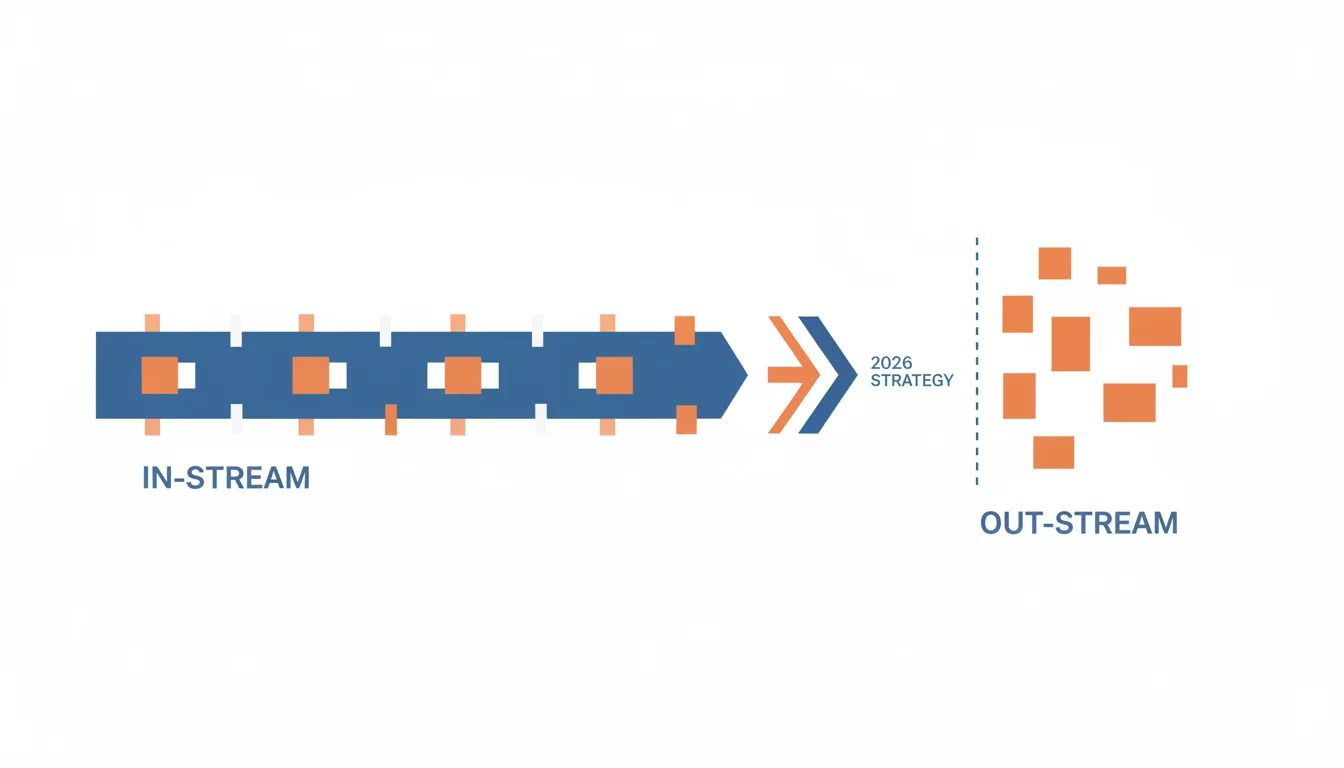
Video advertising has solidified its position as a foundation of digital marketing strategies in 2026, yet simply creating compelling video content isn’t enough. Where that video appears deeply impacts its effectiveness. The choice between in-stream ads and out-stream ads dictates everything from viewer perception to campaign cost, forcing marketers to make calculated decisions. But what truly differentiates these placements, and how can businesses select the right strategy for their objectives?
Understanding In-Stream Video Ads: The Immersive Experience
In-stream ads are video advertisements that play before, during, or after video content a user has actively chosen to watch. Think of them as the digital equivalent of television commercials, integrated directly into the viewing experience. This category primarily includes pre-roll, mid-roll, and post-roll formats. Pre-roll ads, appearing before the main video, are arguably the most common and often boast the highest completion rates because the viewer is awaiting their desired content. Mid-roll ads, interrupting longer video content, can achieve strong engagement but risk user frustration if not placed strategically. Post-roll ads, playing after the main video, generally see lower completion rates as viewers may navigate away once their primary interest is satisfied. The defining characteristic of in-stream advertising is its inherent viewability. Because the ad is embedded within content the user intends to watch, the likelihood of it being seen, and often heard, is significantly higher. According to a 2025 IAB report on video advertising trends, average viewability for in-stream formats across premium publishers exceeded 92%, a figure that consistently outperforms most other digital ad formats. This high viewability translates directly to brand exposure and message recall. However, this premium placement comes at a cost. In-stream inventory, particularly for pre-roll on popular platforms, can be more expensive due to its demand and proven effectiveness. Advertisers often see higher CPMs (cost per mille, or cost per thousand impressions) for these placements compared to out-stream options. For instance, campaigns targeting specific demographic segments on major video platforms might see CPMs ranging from $25 to $50 or even higher for highly sought-after inventory, depending on factors like audience, geography, and ad length. The user experience with in-stream ads is a double-edged sword. On one hand, the ad is delivered in a high-attention environment. Users are typically settled in to watch video, making them potentially more receptive to a video message. On the other hand, forced exposure can lead to ad fatigue or negative brand perception if the ad is too long, irrelevant, or repetitive. Platforms like Google Ads offer granular control over ad frequency capping, allowing marketers to limit how many times a user sees a particular ad within a given timeframe, a critical setting for maintaining a positive user experience and preventing burnout. The ability to skip ads after a few seconds, a feature common on many platforms, also presents a challenge. Creatives must capture attention within the first 5 seconds to maximize impact before a potential skip.
Exploring Out-Stream Video Ads: Contextual Reach
Out-stream ads, also known as in-read or native video ads, represent a fundamentally different approach to video advertising. Unlike in-stream ads, these units appear outside of traditional video content players. They typically emerge within editorial content, news feeds, or article pages, often starting to play automatically (usually muted) as they scroll into view and pausing when scrolled out of sight. The key differentiator here is that the user is not actively seeking video content when they encounter an out-stream ad. Instead, the video ad is integrated into a text-based or image-based environment. This placement offers significant advantages in terms of scalability and cost-efficiency. Publishers can integrate out-stream units into a vast array of web pages and mobile app screens where traditional video content doesn’t exist, dramatically increasing available inventory. This expanded supply generally leads to lower CPMs compared to in-stream, making out-stream a powerful tool for campaigns focused on broad reach and efficient cost-per-view metrics. A recent analysis by eMarketer indicated that out-stream video ad spending continues to grow, driven by its accessibility and the ability for brands to engage users in new contexts. It’s not uncommon to see out-stream CPMs in the $8 to $20 range, depending heavily on publisher quality and audience targeting. However, the nature of out-stream placement also brings specific challenges. While viewability is still a concern, it’s measured differently. Many platforms define an out-stream ad as “viewable” if at least 50% of its pixels are on screen for at least two consecutive seconds, a standard set by the IAB. This is a lower threshold than the active engagement implied by an in-stream placement. Users have complete control over whether they engage with an out-stream ad. They can easily scroll past it. This means the creative itself must be exceptionally compelling and designed for sound-off viewing, as most out-stream videos begin muted. Subtitles, clear visuals, and a strong opening hook are paramount. Without a captivating visual narrative, the ad may simply become background noise or be ignored entirely. The context surrounding the ad also becomes vital. An out-stream ad for a new electric vehicle placed within an article about sustainable living might perform exceptionally well, whereas the same ad in an article about celebrity gossip might be less effective.
Strategic Considerations for Placement Selection
Choosing between in-stream and out-stream isn’t a matter of one being inherently superior. It’s about aligning the placement with specific campaign objectives. If the primary goal is to drive high video completion rates and immerse the viewer fully in a brand narrative, in-stream ads, particularly pre-roll, are often the preferred choice. These placements are ideal for brand awareness campaigns where a complete message delivery is critical, or for product launches requiring detailed explanation. The higher cost is justified by the higher engagement and viewability. Conversely, if the objective is to maximize reach, generate a high volume of views at a lower cost, and introduce the brand to a broader audience, out-stream ads shine. They are excellent for driving traffic to a landing page, increasing brand recall through repeated exposure across diverse contexts, or for retargeting campaigns where the goal is to keep the brand top-of-mind without demanding full video consumption. A key consideration here is the creative. Because out-stream ads are often encountered passively, the video needs to communicate its core message effectively even without sound. Many agencies now produce specific cuts of video ads tailored for out-stream, emphasizing visual storytelling and incorporating clear on-screen text. Plus, the target audience’s media consumption habits play a significant role. Younger demographics, accustomed to short-form content and quick scrolling, might engage differently with out-stream units than older audiences who may be more receptive to longer, embedded in-stream experiences. Data from Nielsen’s 2026 Media Consumption Report suggests that while overall video consumption remains high, the platforms and formats preferred vary considerably by age group and content type. It’s not enough to simply assume. Strong audience research and A/B testing across different placements are essential to validate assumptions and refine strategy.
| Feature | In-Stream Ads | Out-Stream Ads | Pre-Roll Ads |
|---|---|---|---|
| Placement Type | Within video content | Within non-video content | Before main video content |
| Average Viewability | Often >90% (e.g., 92%) | Variable, measured differently | Inherently high viewability |
| Completion Rates | High (e.g., 70%+ for short ads) | Lower, users can scroll past | Highest (some platforms >70%) |
| Cost-per-View (CPM) | Higher ($25-$50+) | Lower ($8-$20) | Higher, due to demand |
| Scalability | Limited by video inventory | Greater, vast non-video inventory | Limited by video inventory |
| User Experience | High attention, potential fatigue | Integrated, can be skipped easily | User awaiting content, high receptivity |
| Creative Requirement | Impactful within 5s | Strong, attention-capturing | Impactful within 5s for skips |
Optimizing Creative for Each Format
The effectiveness of any video ad campaign hinges not just on placement but critically on the creative itself. For in-stream ads, especially pre-roll, the initial seconds are paramount. A strong hook is necessary to prevent users from skipping. Brands should aim for clear, concise messaging, often building towards a call-to-action (CTA) that appears early in the ad. For example, a 15-second pre-roll ad might dedicate the first 3-5 seconds to establishing a problem or an intriguing visual, the next 7-10 seconds to presenting the solution or product, and the final seconds to a prominent, actionable CTA. High production value is often expected here, aligning with the premium content the user is about to watch. Out-stream ads demand a different creative approach entirely. As mentioned, they typically play muted, so visual storytelling must carry the weight of the message. This often means prominent on-screen text, clear product demonstrations, and engaging animations. Consider the example of an out-stream ad for a new mobile game: instead of relying on sound effects, the ad might show dynamic gameplay footage with text overlays highlighting key features or a limited-time offer. The ad should be designed to capture attention as it scrolls into view, delivering its core message quickly before the user scrolls past. Many advertisers find success with shorter out-stream ads, often 6 to 15 seconds, focusing on a single, compelling idea. Longer out-stream ads risk being ignored before they can deliver their full message. Both formats benefit from clear branding and a consistent visual identity. Regardless of where the ad appears, the brand logo and aesthetic should be immediately recognizable. This strengthens brand recall and ensures that even if a user only sees a snippet of the ad, they associate it with the correct company. I’ve often seen campaigns where a client insists on using the same long-form creative for both in-stream and out-stream, and it almost always underperforms in the out-stream environment. It just doesn’t work. The user context is too different. You need to adapt, not just repurpose.
Measuring Success: Metrics for In-Stream vs. Out-Stream
Measuring the performance of in-stream ads and out-stream ads requires attention to different metrics, reflecting their distinct objectives and user interactions. For in-stream campaigns, key performance indicators (KPIs) often center around completion rates, viewability, and engagement. A high video completion rate (VCR), for instance, indicates that a significant percentage of viewers watched the ad to its conclusion, suggesting strong audience interest or effective placement before desired content. Click-through rates (CTRs) remain important, especially for driving immediate action, but VCR often takes precedence for brand awareness. Metrics like brand lift studies, which measure changes in brand recall, favorability, and purchase intent, are also particularly relevant for in-stream due to its immersive nature. For out-stream campaigns, the focus shifts towards reach, cost-efficiency, and initial engagement. While viewability is still measured, the definition is often less stringent, as previously discussed. Key metrics include cost per completed view (CPCV), which can often be significantly lower than in-stream, and the total number of unique users reached. Since these ads are often integrated into content feeds, metrics like scroll depth and time on page can indirectly indicate user exposure, though direct engagement with the ad itself (e.g., clicks to expand, unmuting) is more definitive. The sheer volume of impressions and views attainable through out-stream makes it a strong contender for building broad audience segments for subsequent retargeting efforts. In the end, a well-rounded approach that leverages both in-stream for deep engagement and out-stream for expansive reach will often yield the most strong campaign results, provided the creative is optimized for each environment. The evolving digital video field demands a nuanced understanding of ad placement strategies. While in-stream ads offer unparalleled viewability and completion rates for immersive brand storytelling, out-stream ads provide scalable reach and cost-efficiency, engaging audiences in new and diverse contexts. Marketers must carefully weigh their campaign goals, audience behavior, and creative capabilities to select the optimal mix, ensuring their video messages resonate effectively in a crowded digital world. CMOs need a strong video ad strategy.
What is the primary difference between in-stream and out-stream video ads?
In-stream ads play directly within video content that a user has actively chosen to watch (e.g., YouTube pre-roll), while out-stream ads appear in non-video environments like editorial articles or news feeds, often playing automatically as they scroll into view.
Which type of video ad typically has higher viewability?
In-stream ads generally boast higher viewability rates, often exceeding 90%, because they are embedded within content the user is actively consuming, making them harder to ignore.
Are out-stream ads more cost-effective than in-stream ads?
Yes, out-stream ads are typically more cost-effective on a per-impression or per-view basis due to the larger inventory available across various publishers and websites where traditional video content might not exist.
How should creative be adapted for out-stream video ads?
Out-stream ad creative should be designed for sound-off viewing, relying heavily on strong visuals, clear on-screen text, and concise messaging to capture attention quickly before a user scrolls past the ad unit.
When should a marketer prioritize in-stream over out-stream, or vice versa?
Prioritize in-stream for campaigns focused on high video completion rates, deep brand engagement, and immersive storytelling. Choose out-stream for broad reach, cost-efficient views, and introducing the brand across diverse contextual environments.


