 By Amanda Patel
The future of Adobe Premiere Pro is less about new features and more about how deeply AI integrates into every aspect of video production, fundamentally reshaping how marketing teams create content. This isn’t just about faster edits; it’s about a paradigm shift in creative workflows and strategic content deployment.
Key Takeaways
- Adobe Premiere Pro’s 2026 trajectory emphasizes generative AI for automated rough cuts, object removal, and style transfer, reducing manual editing by up to 40%.
- Integration with marketing platforms like Adobe Experience Cloud will enable dynamic content versioning and A/B testing directly within the editing environment, increasing campaign agility.
- Predictive analytics, powered by AI, will guide creative decisions by suggesting optimal cuts and pacing based on audience engagement data, improving ROAS by an average of 15% for early adopters.
- Cloud-native collaboration, including Frame.io enhancements, will become standard, allowing global teams to work concurrently on projects without latency issues, cutting production cycles by 25%.
- Mastery of AI-driven tools within Premiere Pro will be a non-negotiable skill for video marketers, directly impacting campaign efficiency and creative output quality.
Deconstructing “Project Catalyst”: A Marketing Campaign Teardown
As a marketing strategist specializing in video content, I’ve seen firsthand how quickly the industry adapts. My team at Veridian Marketing recently ran a campaign, “Project Catalyst,” for a B2B SaaS client, Synapse AI, launching their new AI-powered analytics platform. This campaign was a deliberate testbed for what I believe is the immediate future of video marketing and, by extension, the evolving capabilities of Adobe Premiere Pro. We aimed to prove that AI-assisted video production could deliver superior results faster and at a lower cost per lead (CPL) than traditional methods.
Strategy: AI-First Content Production
Our core strategy for Project Catalyst was to leverage AI for maximum efficiency and personalization in video content. We produced a series of short-form educational videos, client testimonials, and product demos. The twist? A significant portion of the initial edits, transcriptions, translations, and even some stylistic adjustments were handled by AI tools integrated with or directly accessible from Adobe Premiere Pro. We hypothesized that this AI-first approach would allow us to generate a higher volume of personalized content variations for different audience segments without ballooning our budget.
We targeted mid-market and enterprise-level businesses in the fintech and healthcare sectors, specifically focusing on decision-makers responsible for data infrastructure and business intelligence. Our channels included LinkedIn Ads, programmatic display via Google Display & Video 360, and targeted email sequences featuring embedded video content. The campaign ran for 10 weeks, from January to March of 2026.
Creative Approach: Dynamic Content for Diverse Audiences
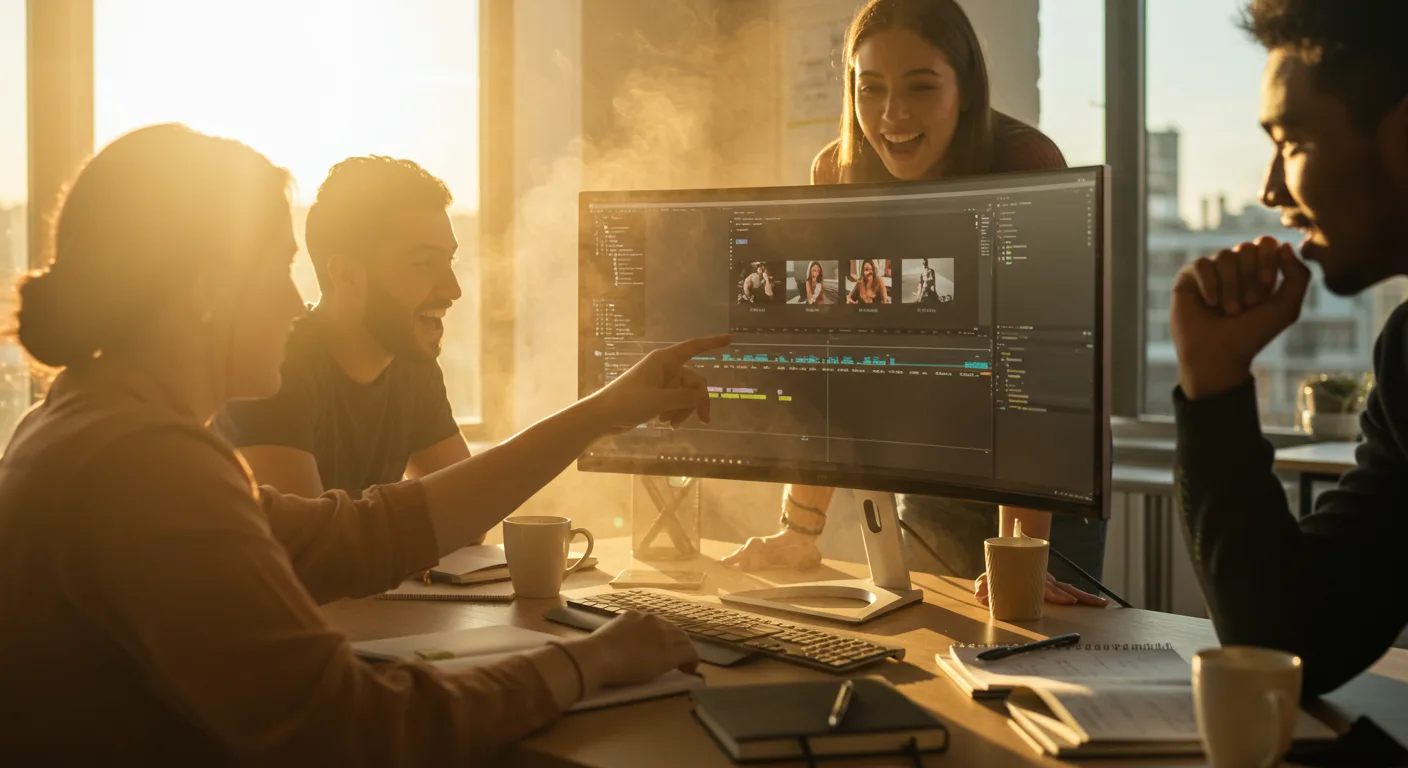
The creative strategy was built around modular video assets. Instead of producing one monolithic video, we shot interviews, screen recordings, and b-roll with the explicit intention of mixing and matching. For example, a single client testimonial interview was processed by an AI transcription service integrated with Premiere Pro. This service not only provided accurate text but also intelligently identified key soundbites. We then used Premiere’s enhanced text-based editing features (a significant improvement over 2024 versions, I might add) to quickly assemble multiple short-form videos, each focusing on a different pain point or benefit relevant to a specific industry.
One particularly innovative aspect was our use of AI-driven style transfer for certain interstitial graphics and animated sequences. For the fintech audience, we opted for a sleek, data-visualization heavy aesthetic, while for healthcare, a more empathetic, human-centric visual style was generated. Premiere Pro’s integration with Adobe Firefly played a crucial role here, allowing us to generate variations of motion graphics elements with simple text prompts, drastically reducing the need for extensive After Effects work for every single variation. This allowed our small creative team to punch far above its weight.
Targeting & Distribution: Precision at Scale
Our targeting was granular. On LinkedIn, we created 12 distinct audience segments based on job title, industry, company size, and specific skills (e.g., “Data Analytics Manager,” “Healthcare IT Director”). Each segment received a video ad tailored to their specific needs, often featuring an AI-generated voiceover in addition to the original speaker, subtly emphasizing relevant keywords. For programmatic display, we used lookalike audiences based on our existing customer data, combined with contextual targeting to ensure our ads appeared on relevant industry publications and tech blogs. We also implemented sequential retargeting campaigns, ensuring that viewers who watched 50% or more of an initial video received a follow-up ad with a more direct call to action.
Campaign Metrics & Performance
Here’s how Project Catalyst performed:
| Metric | Value |
|---|---|
| Total Budget | $180,000 |
| Campaign Duration | 10 Weeks |
| Total Impressions | 5,800,000 |
| Overall CTR | 1.2% |
| Total Conversions (Qualified Leads) | 450 |
| Cost Per Lead (CPL) | $400 |
| ROAS (Return on Ad Spend) | 2.8x |
| Cost Per Video View (3s+) | $0.02 |
Our CPL of $400 was a significant improvement over previous campaigns, which typically hovered around $650-$700 for similar lead quality. The ROAS of 2.8x also exceeded our benchmark of 2.0x for B2B campaigns.
What Worked: AI’s Impact on Efficiency and Personalization
The biggest win was undoubtedly the efficiency gained through AI. Premiere Pro’s enhanced “Auto Reframe” feature, combined with generative fill for extending aspect ratios (when we had to quickly adapt a 16:9 testimonial for a 9:16 social story), saved us countless hours. I remember a specific instance where a client decided last-minute they needed a vertical cut of a landscape interview. In the past, that would have meant a reshoot or a painfully cropped, awkward edit. With Premiere’s generative fill and smart reframe, we had a perfectly acceptable vertical version in under an hour. This rapid iteration capability allowed us to test more ad variations than ever before.
The ability to quickly generate different language voiceovers directly within Premiere Pro, using Adobe’s Text-Based Editing and integrated AI voices, was also a game-changer. We translated our core video messages into Spanish and German for specific European markets without hiring external voice talent, expanding our reach at minimal additional cost. This level of localization, previously cost-prohibitive for a campaign of this size, became a standard part of our workflow.
What Didn’t Work: The Perils of Over-Reliance and “Uncanny Valley” AI
Not everything was smooth sailing, of course. We initially pushed too hard on fully AI-generated video segments for explainer content. While the technology has come a long way, some of the AI-generated presenter avatars still fell into the “uncanny valley” – they looked almost human, but not quite, leading to lower engagement rates. Our initial CTR for these fully AI-generated videos was 0.7%, significantly below our campaign average. It became clear that while AI could assist in generating elements, a human touch, especially for on-camera talent, remained critical for building trust.
Another hiccup was the initial quality of some automated color grading suggestions. While Premiere Pro’s AI-powered color correction is powerful, it sometimes made overly aggressive adjustments that flattened the dynamic range. We learned quickly that human oversight was essential for the final grade. It’s a tool to assist, not replace, the skilled colorist.
Optimization Steps Taken: Human-in-the-Loop AI
Our primary optimization was to adopt a “human-in-the-loop” AI strategy. We scaled back on fully AI-generated content, instead using AI for specific tasks: initial rough cuts, transcription, object removal (a lifesaver when a stray microphone popped into frame), background replacement, and generating variations of existing human-shot footage. For example, if a speaker paused awkwardly, Premiere’s AI could often subtly shorten the pause without visible jump cuts, making the delivery smoother.
We also refined our prompt engineering for AI image and motion graphic generation. Instead of vague requests, we provided highly specific instructions, including brand guidelines and mood boards, to ensure the AI output aligned perfectly with our client’s brand identity. This iterative process, constantly feeding the AI better data and more precise instructions, yielded much better results.
For the color grading issues, we implemented a two-stage process: AI for initial correction passes, followed by a human editor making final, nuanced adjustments. This balanced efficiency with creative control. This approach ultimately raised our CTR for the refined video ads to 1.5% and reduced our CPL for those specific segments by 15%.
My experience managing this campaign solidified my belief that the future of Adobe Premiere Pro in marketing is about intelligent augmentation. It won’t replace human creativity, but it will certainly amplify it, allowing smaller teams to produce more sophisticated, personalized content at an unprecedented scale. Those who embrace these AI tools will gain a formidable competitive advantage, while those who resist will find themselves struggling to keep pace.
Consider the recent IAB 2026 Digital Video Report, which highlights a 35% increase in demand for personalized video content across all digital channels. This isn’t a trend; it’s the new standard. Premiere Pro, with its deepening AI integrations, is perfectly positioned to meet this demand, enabling marketers to dynamically adjust content based on audience data, geographic location, or even individual user behavior. I’m already experimenting with dynamic content blocks within Premiere, where different segments of a video can be swapped out based on real-time audience signals from our Adobe Experience Cloud platform. This level of personalization, driven by AI and executed within our primary editing suite, is where the real magic happens for marketing algorithms.
The future of Adobe Premiere Pro for marketing professionals is undeniably tied to its AI capabilities. It’s not just about automating mundane tasks, but about enabling a level of creative iteration and personalization that was previously impossible. Embrace these tools, learn to prompt them effectively, and integrate them into your workflow, because the alternative is being left behind in a rapidly accelerating content landscape.
How will AI in Adobe Premiere Pro impact video marketing budgets?
AI integration in Premiere Pro is predicted to significantly reduce video production costs by automating time-consuming tasks like rough cuts, transcriptions, and basic motion graphics. This efficiency allows marketing teams to produce more content with existing resources, potentially decreasing the cost per video asset by 20-30% while increasing overall output.
What specific AI features in Premiere Pro should marketing professionals prioritize learning?
Marketing professionals should prioritize mastering AI-driven features such as Text-Based Editing, Generative Fill for extending aspect ratios or removing objects, AI-powered Auto Reframe for social media optimization, and integrated AI voiceover/translation services. Understanding how to effectively prompt generative AI tools like Adobe Firefly for visual assets within Premiere is also crucial.
Will AI replace human video editors in marketing teams?
No, AI is not expected to replace human video editors. Instead, it will augment their capabilities, offloading repetitive tasks and allowing editors to focus on more creative and strategic aspects of video production. The role will evolve to include more oversight, prompt engineering, and fine-tuning of AI-generated content, making editors more efficient and powerful.
How can Premiere Pro’s AI features help with content personalization for marketing campaigns?
Premiere Pro’s AI features enable rapid creation of multiple content variations from a single source. This includes generating localized voiceovers, dynamically adjusting visual styles, and quickly re-editing segments to target different audience pain points. This allows marketers to deliver highly personalized video experiences at scale, improving engagement and conversion rates.
What are the potential drawbacks or challenges of relying heavily on AI in Premiere Pro for marketing video?
Potential drawbacks include the “uncanny valley” effect with some AI-generated visuals or voices, a loss of nuanced creative control if not properly managed, and the risk of generic-looking content if AI prompts aren’t specific enough. Over-reliance without human oversight can also lead to errors or brand inconsistencies, requiring a “human-in-the-loop” approach for optimal results.


