 By Editorial Team
Many marketers struggle to quantify the true impact of their video advertising. They pour significant budgets into campaigns, see impressive impression and click-through rates, yet remain unsure if those ads genuinely drive new conversions or merely capture demand that would have materialized anyway. This inability to isolate the unique contribution of video ads creates a significant blind spot, leading to misallocated budgets and missed growth opportunities. The solution lies in robust incrementality testing, which provides a clear, data-driven answer to the elusive question of video ad value.
Key Takeaways
- Implement a holdout group methodology for incrementality testing, ensuring a statistically significant portion of your target audience is excluded from video ad exposure.
- Focus on measuring a true business metric like conversions or revenue, not proxy metrics such as impressions or clicks, to determine video ad effectiveness.
- Allocate 10 to 15 percent of your video ad budget to incrementality testing to gain actionable insights into media efficiency.
- Conduct incrementality tests on major platforms like YouTube Ads or Meta Advantage+ campaigns, leveraging their native A/B testing features where available.
- Iterate on your video ad creative and targeting based on incrementality results, continuously refining campaigns for higher incremental lift.
The Problem: Measuring True Impact in a Complex Ecosystem
Attribution models have their place, certainly. They help us understand paths to conversion. But they often fall short when trying to isolate the incremental impact of a single channel, especially one as pervasive as video advertising. We see a user watch a video ad, then convert, and our last-click or even multi-touch models might credit that video. The problem? We don’t know if that user would have converted anyway, perhaps after seeing a display ad or searching directly. This isn’t just academic; it’s a fundamental challenge for budget allocation. If your video ads are simply accelerating conversions that were already inbound, you’re not generating new business. You’re just paying for what you might have gotten for free, or cheaper.
The digital advertising landscape of 2026 presents more complexity, not less. With privacy changes, evolving tracking technologies, and a proliferation of platforms, understanding causation versus correlation has become even harder. Many teams still rely on proxy metrics like view-through conversions or post-view engagements, which can be misleading. A high view-through rate might just mean your ads are reaching people already predisposed to convert. It offers little insight into whether the ad itself caused a new conversion. This misunderstanding leads to inflated performance reports and and, critically, a misdirection of marketing dollars. You might be celebrating what looks like strong video performance, all while leaving significant growth on the table because you haven’t identified your true incremental drivers.
| Aspect | Traditional Measurement | Incrementality Testing |
|---|---|---|
| Primary Goal | Understand conversion paths | Isolate true ad impact |
| Key Metric Focus | Impressions, clicks, view-throughs | Conversions, revenue (true business metrics) |
| Budget Allocation | Often blind to true impact | Allocate 10-15% for insights |
| Methodology | Attribution models, pre/post campaign analysis | Holdout group, A/B testing |
| Risk of Misdirection | High (inflated performance reports) | Low (data-driven budget allocation) |
| Platform Reliance | Blind trust in platform metrics | Independent verification of value |
What Went Wrong First: Misguided Approaches to Video Ad Measurement
Early attempts at measuring video ad impact often stumbled over methodological flaws. A common mistake involved simple A/B tests where one group saw video ads and another didn’t, but the groups weren’t truly isolated or randomized. Perhaps the “control” group was simply a segment of the audience that was cheaper to reach, introducing selection bias. Or, even worse, marketers would compare performance before and after a video campaign launched, attributing any uplift solely to the video. This ignores seasonality, competitor activity, product changes, and a host of other variables that influence consumer behavior. We’ve all seen those charts, haven’t we, where a new campaign launches and a metric jumps, and the conclusion is drawn too quickly? It’s tempting, but it’s rarely accurate.
Another prevalent misstep was the overreliance on platform-reported metrics without independent verification. While platforms like YouTube Ads and Meta Advantage+ campaigns offer valuable data, their primary goal is to demonstrate their own value. Their attribution models, by default, often lean towards crediting their own touchpoints. This isn’t malice; it’s just how the system is designed. Trusting these numbers blindly without an independent incrementality check is akin to letting the fox guard the henhouse. It gives an incomplete, and often overly optimistic, picture of your actual return on investment.
Finally, many marketers focused on easily measurable, but ultimately less meaningful, metrics. They tracked video completion rates, engagement rates, or even brand lift studies, which, while providing some qualitative insight, don’t directly answer the question: “Did this video ad make someone convert who wouldn’t have otherwise?” Brand lift is important, yes, but it’s a long-term play. When you’re assessing immediate campaign efficiency, you need a more direct link to revenue. Without that direct link, you’re operating on a hunch, not on data.
The Solution: A Step-by-Step Guide to Incrementality Testing
To truly understand the video ad value, you must employ a rigorous incrementality testing framework. This isn’t optional; it’s essential for any serious marketer in 2026. The core principle involves creating a statistically significant control group that is intentionally not exposed to your video advertising, while the test group is. By comparing the outcomes of these two groups, you can isolate the true incremental impact of your video campaigns.
Step 1: Define Your Hypothesis and Key Metric
Before launching any test, articulate what you expect to happen and what you will measure. Your hypothesis might be: “Exposing users to our new video ad will increase conversions by X% compared to those not exposed.” Your key metric should be a tangible business outcome, such as purchases, sign-ups, or lead submissions. Avoid vanity metrics. We’re looking for real business impact here.
Step 2: Establish a True Holdout Group
This is the most critical step. You need a group of users who are part of your target audience but will genuinely not see your video ads. This isn’t about simply pausing campaigns for a segment. You need to actively prevent exposure. For instance, on platforms like YouTube, you can often create a custom audience segment and then exclude it from your video campaigns while targeting all other eligible users. The size of this holdout group is vital for statistical significance. A common approach is to allocate 10 to 15 percent of your target audience to the control group. Google Ads documentation offers guidance on setting up experiments, including holdout groups, for various campaign types. Remember, true randomization across your target audience is paramount. If your holdout group is inherently different from your test group, your results will be skewed.
Step 3: Run the Campaign and Collect Data
Launch your video ad campaigns, ensuring the holdout group remains unexposed. Let the test run for a sufficient duration to gather enough data for statistical significance. This period will vary depending on your conversion volume and audience size, but typically ranges from two to four weeks. During this time, meticulously track your chosen key metric for both the exposed (test) group and the unexposed (control) group. Ensure your conversion tracking is robust and consistent across both segments.
Step 4: Analyze and Interpret Results
Once the test concludes, compare the performance of your test group against your control group. Calculate the difference in your key metric (e.g., conversion rate, average order value) between the two. This difference represents the incremental lift attributable to your video ads. For example, if your test group had a 5% conversion rate and your control group had a 4% conversion rate, your video ads generated a 1% incremental lift. This 1% is your true incremental value, not the total 5%. You’ll also want to perform statistical significance tests to ensure your observed difference isn’t due to random chance. Tools like an A/B test significance calculator can help with this. Don’t just look at the raw numbers; understand the probability that your results are real.
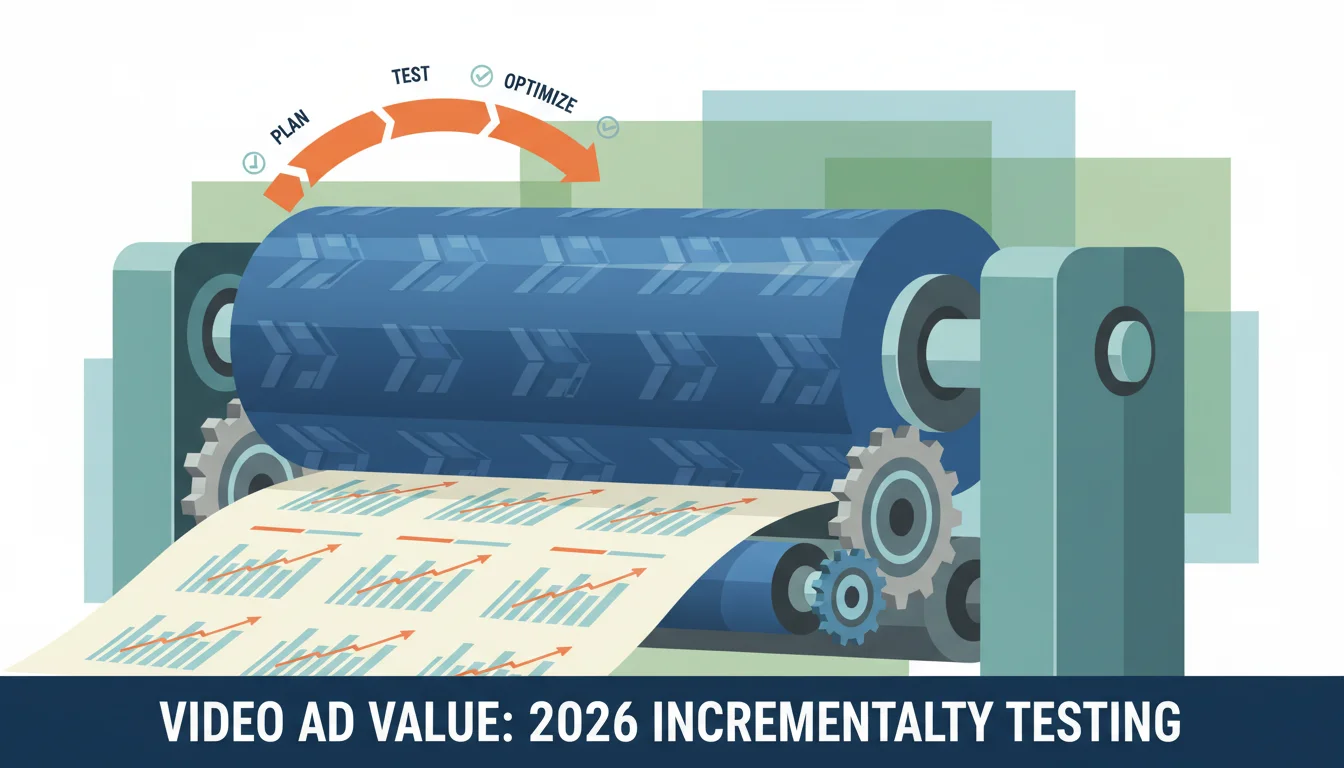
Step 5: Iterate and Optimize
The analysis isn’t the end; it’s the beginning. If your video ads generated significant incremental lift, great! Now, can you make them even more effective? Experiment with different creatives, targeting parameters, or bidding strategies. If the lift was minimal or non-existent, it’s a clear signal that your current video strategy isn’t working as intended. This might mean pausing those campaigns, re-evaluating your creative message, or even exploring entirely different channels. The beauty of incrementality testing is that it provides actionable insights, not just numbers. It tells you what to do next.
The Results: Data-Driven Budget Allocation and Growth
Implementing a consistent incrementality testing framework transforms your video advertising from a speculative spend into a measurable growth engine. The primary result is a clear understanding of your true return on ad spend (ROAS) for video. Instead of guessing, you know precisely how much new revenue or how many new customers your video ads are generating. This allows for intelligent budget reallocation. If a particular video campaign delivers a 20% incremental lift in conversions, you can confidently increase its budget. Conversely, if another campaign shows zero incremental impact, you can reallocate those funds to more effective channels or test new video strategies.
Beyond immediate ROAS, incrementality testing fosters a culture of continuous improvement. You’re no longer just running campaigns; you’re conducting experiments. Each test provides valuable data points that inform future creative development, audience segmentation, and platform choices. For example, a recent IAB report highlighted the increasing importance of testing diverse video formats, from short-form vertical videos to longer-form narratives. Incrementality testing helps you discern which of these formats truly resonates and drives new business, rather than just racking up views.
Ultimately, the result is more efficient marketing spend and accelerated business growth. You move away from chasing impressions and towards driving tangible outcomes. This isn’t just about saving money; it’s about maximizing your impact. By focusing on what truly moves the needle, you ensure every dollar spent on video advertising contributes directly to your bottom line. It’s a fundamental shift from “spending money on ads” to “investing in growth.”
Incrementality testing is not a one-time setup; it’s an ongoing discipline. The digital landscape changes too quickly for static strategies. Regularly revisiting your assumptions, testing new creatives, and validating your channels ensures your video advertising budget is always working its hardest. This rigorous approach is the only way to truly unlock the full potential of your video ad spend in 2026 and beyond.
What is the main difference between attribution models and incrementality testing?
Attribution models distribute credit for conversions across various touchpoints, showing the path a user took. Incrementality testing, however, isolates the net new conversions caused solely by a specific marketing intervention, like a video ad, by comparing a group exposed to the ad with an identical group that was not.
How large should my holdout group be for a reliable incrementality test?
A common recommendation is to allocate 10 to 15 percent of your total target audience to the holdout group. The exact size depends on your conversion volume and desired statistical significance. Higher conversion rates and larger audiences allow for smaller holdout groups, but always aim for enough data to draw confident conclusions.
Can I use incrementality testing for brand awareness video campaigns?
Yes, but your key metric will differ. For brand awareness, you’d measure incremental lift in metrics like brand recall, brand favorability, or search volume for your brand terms, often using brand lift studies in conjunction with your holdout group. It’s harder to tie directly to revenue, but still valuable for understanding impact.
What are some common pitfalls to avoid when setting up an incrementality test?
Avoid non-randomized control groups, insufficient test duration leading to low statistical significance, and relying solely on platform-reported data without independent analysis. Ensure your control group is truly isolated from the intervention you are testing, preventing spillover.
How frequently should I conduct incrementality tests for my video ads?
The frequency depends on your campaign volume, budget, and the pace of changes in your strategy. For high-spending, evergreen campaigns, quarterly or even monthly tests can be beneficial. For smaller, tactical campaigns, testing new creative or targeting once every few months might suffice. The goal is continuous learning, not just sporadic checks.


