 By David Clarke
Digital ad news reveals a deep market analysis of an industry undergoing a structural shift, moving beyond traditional campaign models to embrace a more integrated, data-driven future. This isn’t just about new platforms. It’s about a fundamental re-evaluation of how brands connect with audiences and measure impact.
Key Takeaways
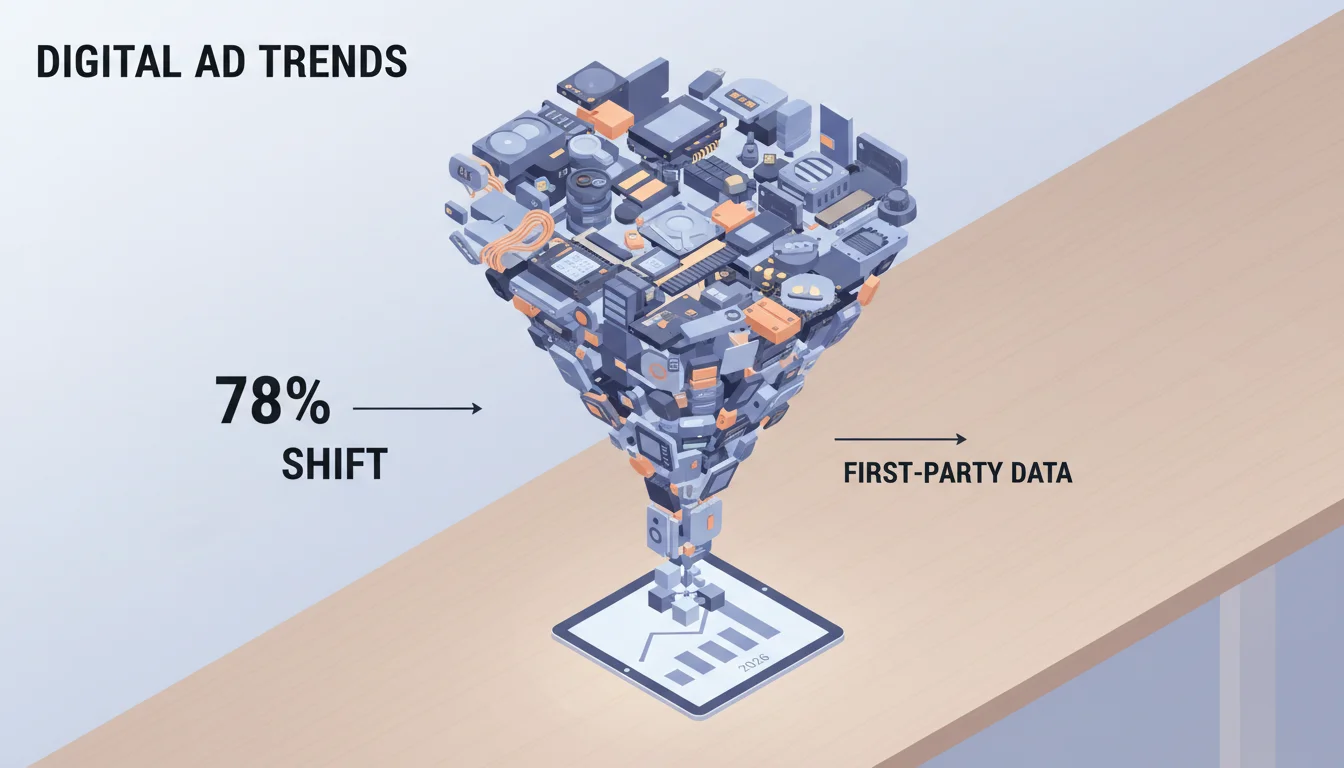
- First-party data strategies are now paramount, with 78% of marketers prioritizing their collection and activation by 2026 to offset third-party cookie deprecation.
- AI-driven automation in ad buying and creative optimization is projected to handle over 60% of routine campaign tasks, freeing up human strategists for higher-level planning.
- Connected TV (CTV) ad spending is set to exceed $30 billion globally, requiring advertisers to adapt creative and measurement approaches for a diverse viewing ecosystem.
- Performance marketing metrics are evolving beyond simple clicks, incorporating brand lift studies and predictive lifetime value models to demonstrate true business impact.
The Era of First-Party Data Dominance
The much-discussed deprecation of third-party cookies by Google Chrome in 2024 has finally reshaped the digital advertising field, pushing first-party data to the forefront of every strategic discussion. This isn’t a minor adjustment. It’s a complete sea change requiring significant investment in data infrastructure and customer relationship management (CRM) systems. Brands that failed to prepare are now scrambling, experiencing diminished targeting capabilities and increased customer acquisition costs. According to a 2025 report from the Interactive Advertising Bureau (IAB) [https://www.iab.com/insights/], 78% of advertisers have significantly increased their budget allocation to first-party data initiatives over the past 18 months, focusing on direct customer interactions through owned channels like websites, apps, and email programs. Building strong first-party data assets involves more than just collecting email addresses. It means understanding customer journeys, preferences, and behaviors across every touchpoint. This requires sophisticated data clean rooms and privacy-preserving technologies to activate segments effectively while adhering to evolving regulations like GDPR and CCPA. The companies winning this race are those that offer genuine value in exchange for data, creating personalized experiences that make customers willing to share information. Think loyalty programs, exclusive content, or early access to products. Without this value exchange, data collection becomes a one-sided transaction, leading to consumer distrust and poor data quality. My own experience working with numerous brands confirms this: the ones who treat data as a partnership, not just a resource, consistently achieve better engagement rates and higher return on ad spend (ROAS).
AI and Automation: Reshaping Campaign Management
Artificial intelligence (AI) and machine learning (ML) are no longer futuristic concepts in digital advertising. They are fundamental operational tools. From programmatic ad buying to dynamic creative optimization, AI is automating processes that once consumed countless hours of human effort. A recent eMarketer [https://www.emarketer.com/] analysis projects that by 2026, AI will manage over 60% of routine ad operations, including bid management, budget allocation, and even initial ad copy generation. This shift frees up marketing teams to focus on higher-level strategy, creative conceptualization, and deep audience insights, rather than manual campaign adjustments. Consider the evolution of programmatic advertising. What began as automated bidding has matured into sophisticated AI algorithms that predict audience responses, optimize ad placements in real-time, and even detect ad fraud with increasing accuracy. Platforms like Google Ads [https://support.google.com/google-ads] and Meta Business Manager [https://www.facebook.com/business/help] continue to integrate more powerful AI features, offering “Performance Max” or “Advantage+” campaigns that autonomously manage multiple ad formats across various channels. While these tools offer immense efficiency, they also demand a new skill set from marketers: the ability to effectively audit AI outputs, understand algorithmic biases, and provide the right inputs to guide the machine learning models. Simply setting it and forgetting it is a recipe for wasted spend. Intelligent oversight is paramount.
The Rise of Connected TV (CTV) and Retail Media Networks
The fragmentation of television viewing habits has propelled Connected TV (CTV) into a dominant advertising channel. With traditional linear TV viewership declining steadily, audiences are migrating to streaming services, creating a vast new inventory of addressable ad space. Nielsen [https://www.nielsen.com/insights/] data from late 2025 indicated that streaming now accounts for more than 40% of total TV viewing in the United States, a figure that continues to climb. This presents a massive opportunity for advertisers to reach engaged audiences with targeted, measurable campaigns that blend the impact of television with the precision of digital. However, CTV advertising comes with its own set of complexities. The ecosystem is fragmented, encompassing numerous streaming platforms, ad servers, and measurement solutions. Advertisers must navigate issues like impression discrepancies, fraud, and the challenge of consistent cross-platform attribution. Plus, creative development for CTV needs to evolve beyond repurposed linear TV spots. Interactive elements, shoppable ads, and personalized messaging are becoming standard expectations. Alongside CTV, retail media networks (RMNs) have exploded, using vast amounts of first-party purchase data from major retailers like Walmart Connect [https://www.walmartconnect.com/] and Amazon Ads [https://advertising.amazon.com/]. These networks offer brands a direct path to consumers at the point of purchase, creating a powerful, closed-loop marketing ecosystem. The teamwork between CTV and RMNs, where ads seen on streaming platforms can directly influence purchases on a retail site, represents a significant growth area for performance marketing.
“One recent analysis found that primary-research pages earned 3.3 times more AI citations per page than other content. (See how I just referenced Kevin Indig’s research?)”
Evolving Measurement and Attribution Models
As the digital advertising environment grows more complex, so too do the demands for sophisticated measurement and attribution. The days of simply tracking last-click conversions are long gone, replaced by multi-touch attribution models and a renewed focus on demonstrating true business impact. Marketers are increasingly moving towards incrementality testing and brand lift studies to understand the true value of their campaigns, rather than just correlating ad exposure with sales. A report from HubSpot [https://blog.hubspot.com/marketing/marketing-statistics] in early 2026 highlighted that 70% of marketing leaders now prioritize demonstrating return on investment (ROI) through complete attribution models that account for upper-funnel activities. The shift away from third-party cookies has accelerated the adoption of privacy-centric measurement solutions, including aggregated data reporting, differential privacy techniques, and consent-based tracking. Advertisers are also investing heavily in advanced analytics platforms that can ingest data from disparate sources (CRM, website analytics, ad platforms) and provide a unified view of the customer journey. The challenge lies in harmonizing these diverse datasets while respecting user privacy. It’s an ongoing process, but the industry is clearly moving towards a future where measurement is more strong, less reliant on individual tracking, and more focused on aggregated insights and predictive modeling of customer lifetime value. This requires a deeper understanding of statistical methods and a willingness to move beyond simplistic “last-touch” metrics.
The Imperative of Creative Innovation and Personalization
In an increasingly noisy digital field, creative innovation and hyper-personalization are no longer differentiators. They are table stakes. With audiences bombarded by thousands of ad messages daily, breaking through the clutter requires compelling, relevant, and often interactive content. Generic ads simply get lost. Brands are investing in dynamic creative optimization (DCO) platforms that can generate hundreds or even thousands of ad variations, tailored to specific audience segments, geographic locations, and even real-time contextual signals. This means an ad might show a different product, a different background, or a different call-to-action based on an individual user’s browsing history or weather conditions. The bar for personalization is continually rising. Consumers expect brands to understand their needs and preferences, delivering messages that feel relevant and timely. This extends beyond just product recommendations to personalized content experiences across all channels. For instance, a sports apparel brand might serve an ad featuring running shoes to someone who just searched for marathon training tips, while showing basketball gear to another user who frequently watches NBA highlights. This level of granularity demands sophisticated audience segmentation, strong data integration, and a commitment to continuous A/B testing of creative elements. Frankly, if your creative isn’t evolving as fast as your targeting capabilities, you’re leaving money on the table. The digital advertising field is experiencing a deep transformation, driven by data privacy shifts, AI advancements, and new media consumption patterns. Adapting to these changes requires a proactive approach to data strategy, a willingness to embrace new technologies, and a relentless focus on delivering relevant, personalized experiences to consumers.
What is the primary impact of third-party cookie deprecation on digital advertising?
The primary impact is a significant shift towards first-party data strategies, as advertisers lose access to granular third-party tracking for targeting and measurement. This necessitates brands investing in direct data collection, CRM systems, and privacy-preserving technologies to maintain effective audience engagement.
How is AI changing the role of digital marketers?
AI is automating routine campaign tasks like bid management, budget allocation, and creative optimization, freeing marketers to focus on higher-level strategic planning, creative development, and deep audience analysis. The role shifts from manual execution to intelligent oversight and strategic guidance of AI tools.
Why is Connected TV (CTV) becoming so important for advertisers?
CTV is important because it captures a growing share of television viewership, offering advertisers access to engaged audiences with the targeting capabilities of digital advertising. It combines the broad reach of TV with the precision and measurability typical of online campaigns, making it a powerful channel for brand building and performance.
What are retail media networks and how do they benefit brands?
Retail media networks are advertising platforms offered by major retailers that use their extensive first-party purchase data to target consumers directly on their e-commerce sites and apps. They benefit brands by providing highly relevant ad placement near the point of purchase, offering a closed-loop measurement system from ad exposure to actual sales.
What are the challenges in modern ad measurement and attribution?
Modern ad measurement faces challenges including working through fragmented data sources, ensuring privacy compliance without third-party cookies, and moving beyond last-click attribution to more complete, multi-touch models. The goal is to accurately demonstrate incremental value and true ROI across increasingly complex customer journeys.


