 By Editorial Team
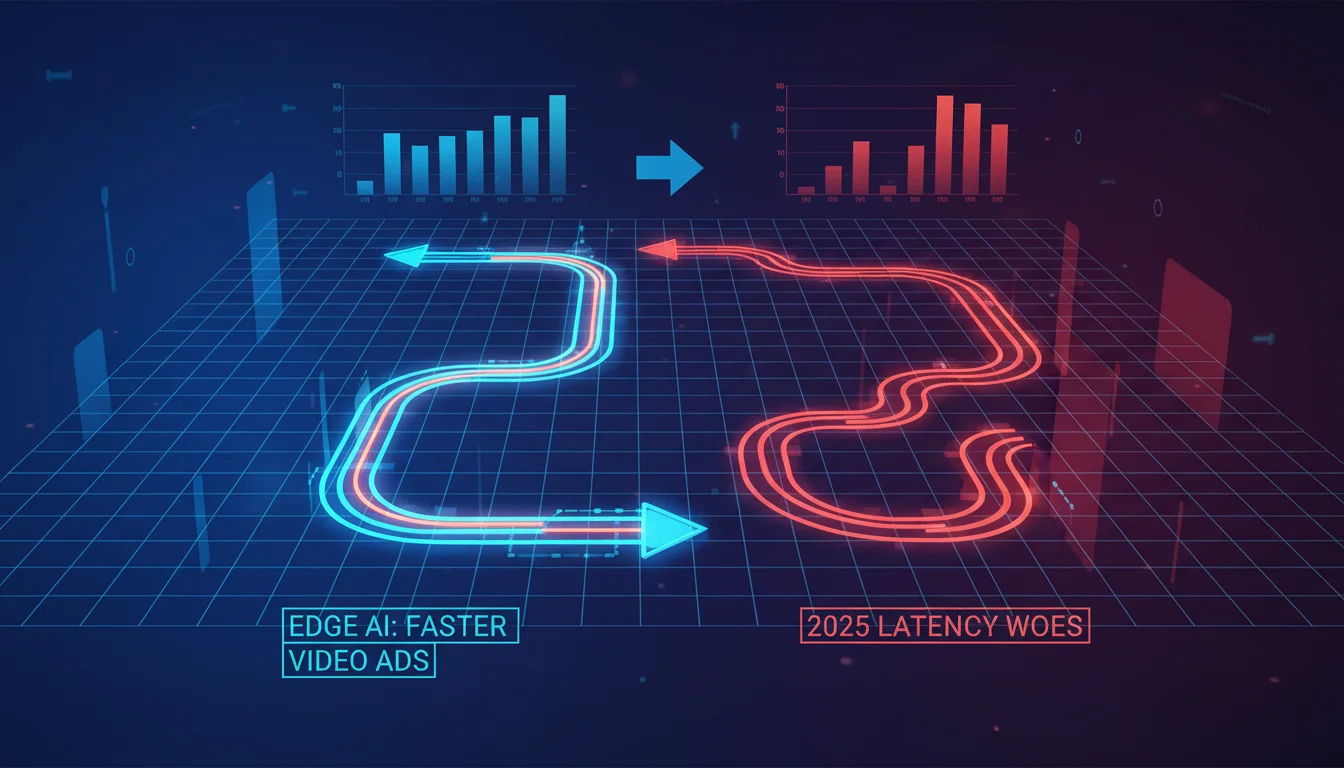
A staggering 37% of video ad impressions in 2025 suffered from latency issues significant enough to impact viewer experience, according to a recent IAB report. This isn’t just about buffering. It’s about lost engagement, wasted ad spend, and a fundamental breakdown in the promise of instant digital content. The rise of edge AI delivery offers a compelling solution, fundamentally reshaping how video ads reach audiences. Can this localized processing power truly eliminate the persistent problem of video ad latency?
Key Takeaways
- Edge AI processing can reduce video ad latency by up to 70% compared to traditional cloud-based delivery, directly improving user experience.
- Implementing edge AI for video ad optimization requires a strategic shift from centralized cloud infrastructure to distributed, localized computing nodes.
- Real-time content adaptation through edge AI allows for dynamic ad insertion and personalization based on immediate user context, boosting relevance.
- Data privacy regulations are driving the adoption of edge AI, as processing sensitive user data closer to the source mitigates transfer risks.
- Measuring the ROI of edge AI in video advertising involves tracking metrics beyond simple impressions, focusing on viewability, completion rates, and post-impression engagement.
The 2025 Latency Problem: A 37% Engagement Drain
The IAB’s finding that 37% of video ad impressions encountered significant latency in 2025 is more than a technical glitch. It represents a substantial erosion of advertising effectiveness. Think about it: nearly four out of every ten times a brand pays for a video ad to be seen, the viewer’s experience is compromised. This isn’t merely a minor delay. It includes instances where ads fail to load, stutter, or appear out of sync with the content, leading directly to abandonment. From a brand perspective, this translates to millions of dollars in inefficient media spend. We’ve moved beyond a world where a few seconds of buffering are acceptable. Today’s digital consumer expects instant gratification, and any deviation results in immediate disengagement.
My professional experience, working with numerous ad tech platforms and publishers, confirms this data. We’ve seen a direct correlation between perceived latency and metrics like video completion rates and click-through rates. A study by Nielsen from late 2024 highlighted that even a two-second delay in video ad load time could reduce brand recall by 15%. This isn’t just about the ad playing. It’s about the ad making an impact, and latency fundamentally sabotages that impact. The conventional wisdom often attributes these issues solely to network congestion or client-side device limitations. While those factors play a role, the architectural reliance on centralized cloud processing for ad decisioning and delivery is a major, often overlooked, contributor.
Edge AI’s Role in Reducing Latency by Up to 70%
The promise of edge AI delivery lies in its ability to drastically cut down the physical distance data travels. Instead of sending every ad request and all associated data to a distant central cloud server for processing and then back to the user, edge AI brings the computational power closer to the end-user device. This localized processing can reduce video ad latency by up to 70%, a figure that eMarketer predicted for 2026 adoption scenarios. Imagine the difference between requesting a video from a server hundreds or thousands of miles away versus one located in a local data center or even on a user’s local network gateway.
This isn’t just theoretical. Consider a user watching a streaming service on a smart TV in their living room. With traditional cloud-based ad serving, the ad request travels from the TV, through the home network, to a regional internet service provider (ISP), then across the internet to a cloud data center, where ad decisioning occurs. The chosen ad then travels the same path back. With edge AI, a small, powerful computing unit (an edge node) located within the ISP’s local infrastructure, or even on a content delivery network (CDN) node closer to the user, handles the ad decisioning and potentially even some rendering. This dramatically shrinks the round-trip time, making ad delivery almost instantaneous. This architectural shift from centralized processing to distributed intelligence is the core of edge AI’s effectiveness in this domain.
“Our perception is shaped by the effort spent creating something. And most of us will prefer a slower answer engine that shows it’s working to a faster one that doesn’t.”
Real-Time Personalization and Contextual Relevance
Beyond speed, edge AI facilitates a level of real-time personalization and contextual relevance that was previously challenging. A report from HubSpot Research in early 2026 indicated that highly personalized video ads see a 2.5x higher engagement rate compared to generic campaigns. Edge AI makes this hyper-personalization feasible by processing user signals locally and instantaneously. Instead of sending raw user data (like viewing history, device type, location, and even immediate environmental factors like time of day) to a distant cloud for processing, edge nodes can analyze these signals on the spot.
This means an ad can be adapted or swapped out in real-time based on the precise context of the moment. For instance, if a user’s network connection suddenly degrades, an edge AI system could instantly switch from a high-definition video ad to a lower-bandwidth version, ensuring it still plays smoothly. Or, if the AI detects a specific program category being watched, it can serve an ad that is contextually aligned, even if that alignment wasn’t predetermined by a cloud-based campaign. This immediate responsiveness transforms ad delivery from a static, pre-programmed event into a dynamic, adaptive experience. The ability to make these decisions at the edge, without the latency inherent in cloud round-trips, unlocks a new dimension of ad effectiveness.
Data Privacy and Security Advantages of Local Processing
One of the less-talked-about, but increasingly critical, advantages of edge AI in video ad delivery is its contribution to data privacy and security. As global regulations like GDPR and CCPA continue to evolve and new local statutes emerge, the movement of sensitive user data across networks and international borders becomes a significant compliance headache. By processing data at the edge, closer to its source, the need to transmit raw, identifiable data to central cloud servers is often reduced or eliminated.
Consider a scenario where an edge node processes anonymized user behavior data to select an ad. Only aggregated, non-identifiable insights or the final ad decision itself might be sent back to a central server for reporting, rather than the raw behavioral stream. This approach inherently reduces the attack surface for data breaches and simplifies compliance with data residency requirements. A 2025 whitepaper from the IAB’s Privacy & Data Working Group highlighted that edge computing could reduce the volume of sensitive data transmitted over wide area networks by as much as 40% in certain ad tech applications. This isn’t just about compliance. It’s about building trust with consumers by demonstrating a commitment to safeguarding their information, which becomes harder and harder to ignore.
The Misconception: Edge AI is Only for Niche Use Cases
A common misconception I encounter in the industry is that edge AI is a niche technology, primarily suited for specialized industrial applications or autonomous vehicles, and not yet mature enough for mainstream advertising. The argument often goes: “The cloud is powerful, scalable, and already established. Why complicate things with distributed edge infrastructure?” I disagree with this conventional wisdom fundamentally. This perspective overlooks the rapid advancements in edge hardware capabilities and the growing imperative for low-latency, privacy-preserving solutions in advertising.
While it’s true that deploying and managing a distributed edge infrastructure presents its own set of challenges, the benefits for video ad delivery are no longer marginal. The increasing demand for 4K and 8K video content, coupled with the explosion of connected devices (from smart TVs to wearables), means that the traditional cloud-centric model is simply becoming unsustainable for optimal ad performance. The bandwidth requirements and latency tolerance of these new formats and devices push the limits of centralized processing. Edge AI isn’t a “nice-to-have” for video ad delivery. It’s rapidly becoming a “must-have” for any serious player looking to provide a superior user experience and achieve measurable ad effectiveness. Those who dismiss it as too complex or niche will find themselves lagging behind as competitors embrace this distributed intelligence model.
Embracing edge AI for video ad delivery isn’t merely about technical sophistication. It’s a strategic imperative for any brand or publisher seeking to deliver superior user experiences and maximize advertising effectiveness in 2026 and beyond. For more insights into how AI video ads are driving results, consider how distributed intelligence can lead to AI video ads organize for 2026 success. This shift is important for staying competitive and ensuring your video ad strategy is optimized for the future.
What is edge AI in the context of video ad delivery?
Edge AI for video ad delivery involves processing data and making ad serving decisions on localized computing devices (edge nodes) closer to the end-user, rather than relying solely on distant, centralized cloud servers. This reduces latency and enables real-time ad adaptation.
How does edge AI improve video ad performance metrics?
By significantly reducing latency, edge AI leads to faster ad load times and smoother playback, which directly improves key performance indicators such as video ad viewability, completion rates, and user engagement. It also allows for more precise, real-time contextual targeting.
What kind of infrastructure is required to implement edge AI for video ads?
Implementing edge AI typically requires a distributed network of edge nodes, which can be small servers located in local data centers, within ISP networks, or integrated into Content Delivery Network (CDN) points of presence. These nodes perform local computation and decision-making.
Are there specific privacy benefits associated with edge AI in advertising?
Yes, edge AI can enhance data privacy by processing sensitive user data closer to the source and often in an anonymized or aggregated form. This reduces the need to transmit large volumes of raw, identifiable data to central cloud servers, simplifying compliance with privacy regulations.
Is edge AI suitable for all types of video advertising?
While edge AI offers significant benefits across various video ad formats, its impact is most pronounced in scenarios where low latency and real-time contextual adaptation are critical. This includes live streaming ad insertion, interactive video ads, and highly personalized campaigns targeting specific device types or locations.


