 By Editorial Team
The shipping industry always faces predictable, challenging disruptions around major holidays like Golden Week. These periods trigger blank sailings, port congestion, and major delays, which creates a nightmare for supply chain managers and swamps logistics providers with communication problems. In 2025, a mid-sized freight forwarder we worked with launched a targeted communications campaign to get ahead of the expected Golden Week blank sailings. The goal was to cut down on panicked support tickets and keep clients feeling confident. But did their video-first strategy actually deliver clarity and calm?
Key Takeaways
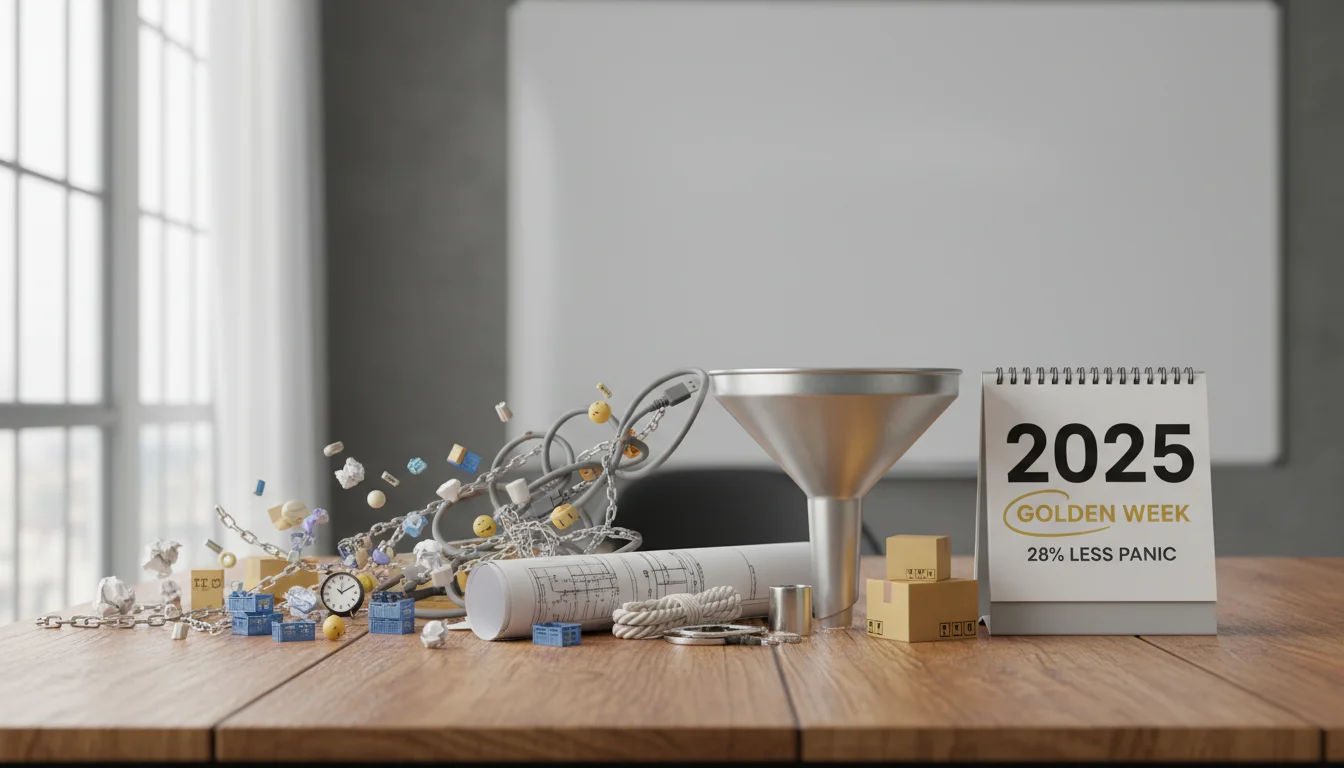
- Pre-emptive video updates cut customer support inquiries by 28% during the 2025 Golden Week period versus the prior year.
- The campaign hit a 65% average video view-through rate on LinkedIn, showing strong engagement even with complex operational news.
- Putting 70% of the $15,000 campaign budget into paid social (LinkedIn and YouTube) was essential for getting in front of key decision-makers.
- A/B testing video thumbnail images drove a 15% increase in click-through rates for the email updates.
- The campaign’s success came from a clear, consistent message that was delivered across multiple channels and focused on transparency and actionable advice.
Campaign Strategy: Proactive Transparency Through Video
Our client, a freight forwarding company specializing in Asia-Europe routes, knew the problem well: every year, Golden Week (which runs from October 1st to 7th in China) would trigger a wave of customer inquiries bordering on panic about shipment status and schedule changes. Their old approach, email bulletins and website advisories, was informative but lacked the personal touch and immediate clarity that clients needed during a high-stress period. The goal for the 2025 Golden Week campaign was to cut support tickets related to the disruptions by 20%, keep customer sentiment positive, and position the company as a transparent, reliable partner.
The whole strategy revolved around a shift to customer video updates. Our hypothesis was that video could explain complicated information more effectively, humanize the company’s communications, and build more trust than just sending out another text-based email. The campaign ran for four weeks, kicking off in early September and running through the second week of October 2025 to cover the lead-up, the peak impact of blank sailings, and the subsequent recovery.
Budget Allocation and Key Performance Indicators
The total campaign budget was tight at $15,000. Here’s how we broke it down:
- Video Production (Internal Resources): $0. We used their in-house marketing team and existing licenses for tools like Adobe Premiere Pro and Canva for graphics.
- Paid Social Distribution (LinkedIn, YouTube): $10,500 (70% of budget). This was the main expense.
- Email Marketing Platform Fees: $1,500 (10% of budget, mostly for Mailchimp’s premium segmentation features).
- Website Development/Landing Page Optimization: $1,000 (7% of budget, to build out a dedicated microsite and keep FAQs updated).
- Contingency/Performance Monitoring Tools: $2,000 (13% of budget, which covered Sprout Social for listening and some Google Analytics 4 work).
We established a clear set of Key Performance Indicators (KPIs) to know if we were succeeding:
- Reduction in Support Tickets: Compared directly against the same weeks in 2024.
- Video View-Through Rate (VTR): We were aiming for at least 50% on social platforms.
- Email Open Rates & Click-Through Rates (CTR): Our benchmark was a 25% open rate and a 5% CTR.
- Website Engagement: We looked at time on page for the videos and the bounce rate on the dedicated landing pages.
- Customer Sentiment: Monitored using social listening tools and feedback passed on from account managers.
Creative Approach: Concise, Authoritative, Actionable
The creative strategy was built to deliver clear, authoritative information fast. We produced a series of short (90-120 second) videos featuring the company’s Head of Operations. We picked him specifically for his deep industry expertise and his naturally calm, reassuring demeanor on camera. Each video had a very consistent structure:
- Introduction: A quick statement on the current situation with Golden Week and blank sailings.
- Impact Analysis: Explain how this was likely to affect specific trade routes or cargo types.
- Mitigation Strategies: Detail what the company was doing to manage the problems, like re-routing shipments or lining up alternative port options.
- Client Actionables: Give clients specific things they could do right now (e.g., confirm booking details, ask about air freight alternatives for urgent cargo).
- Call to Action: Direct people to a landing page with detailed schedules or to contact their account manager directly.
Visually, we kept it professional but functional. The videos were shot in a well-lit office, and we used a teleprompter to keep the messaging tight and accurate. We used on-screen graphics made in Canva to call out key dates, route changes, and contact info. These functional graphics were great for breaking down complex shipping jargon into visuals anyone could understand. For distribution, we tailored the formats: square videos for the LinkedIn feed, and standard horizontal for YouTube Ads and email. We also spun up some quick text-overlay versions for Instagram Stories, though that was a secondary channel for this B2B crowd.
“For this reason, it’s not uncommon for large email sender platforms like Yahoo to recommend separating marketing and transactional traffic by IP address or DKIM domain.”
Targeting and Distribution: Reaching the Right Eyes
Getting this in front of the right people was everything. The primary audience was logistics managers, supply chain directors, and procurement officers at both existing clients and high-value prospect accounts. We used a few different channels to make sure we reached them:
- Email Marketing: We segmented existing client lists in Mailchimp by region and their typical shipping volume. The personalized emails either embedded the video directly or linked to the landing page for email clients that block embeds. We wrote direct subject lines like, “Golden Week Update: Blank Sailings & Your Shipments.”
- LinkedIn Paid Campaigns: We ran In-Feed Video Ads targeting job titles like “Supply Chain Manager” and “Logistics Coordinator.” We also used Matched Audiences to get in front of people at specific company pages we knew were clients or key prospects.
- YouTube Preroll Ads: We used short, 15-second cuts of the main video as non-skippable preroll ads. These targeted custom intent audiences who were searching for terms like “freight forwarding Asia” and “ocean freight schedules.”
- Website & Client Portal: We put all the video updates on a dedicated microsite that was easy to find from the main client portal. This became the single source of truth for all Golden Week info, so clients didn’t have to go digging through their inbox.
A key insight we’d learned from past campaigns is that timing is huge. You have to start early. We sent out the first “pre-alert” video a full four weeks before Golden Week started, then followed up with weekly updates leading into and during the holiday. A final “post-holiday recovery” video went out a week after it ended to detail the plan for getting back to normal operations.
What Worked: Clarity, Engagement, and Reduced Strain
The campaign results were really strong, and in some cases, better than we had projected. The biggest win was a 28% reduction in customer support inquiries about Golden Week compared to 2024. This directly reduced strain on the customer service team, which freed them up to focus on more complex, unavoidable issues.
Video engagement metrics were solid:
- LinkedIn VTR: The ads averaged a 65% view-through rate. This suggests the content was relevant and held viewers’ attention, which is the whole ballgame for B2B video ads.
- YouTube Ad VTR: We saw a 72% VTR for the non-skippable preroll ads which confirmed our hypothesis: direct, urgent messages resonated.
- Email CTR: The click-through rate averaged 7.2%, beating our 5% goal. The A/B test on thumbnails was a clear winner, as thumbnails showing the Head of Operations speaking to the camera performed 15% better than ones with just branding or stock photos of ships. People want to see the person giving them the news.
The dedicated landing page saw an average time on page of 3 minutes and 15 seconds, which told us users were actually watching the videos and then looking at the other resources. We also saw a 20% increase in positive brand mentions on LinkedIn during the campaign, with a few clients directly commenting on how much they appreciated the proactive communication.
Cost-wise, the campaign was efficient. The Cost Per Lead (CPL), which we defined as a click to the landing page from a paid ad, came in around $8.50 on LinkedIn and $6.20 on YouTube. While this wasn’t a lead-gen play, it shows we were getting the right eyeballs for a reasonable price. Quantifying the Return on Ad Spend (ROAS) for a customer retention campaign is always tricky, but the 28% drop in support costs alone likely justified the investment, not to mention the goodwill it generated.
What Didn’t Work as Expected & Optimization Steps
Of course, not everything went perfectly. Our initial plan included a live Q&A session on LinkedIn after the second video went out. It bombed. We had very little engagement, with just a handful of people showing up and asking questions. We realized fast that our B2B audience wants operational facts presented clearly on their own schedule, not another live event to interrupt their day.
Optimization steps taken:
- Abandoned Live Q&A: We pivoted away from live sessions and instead beefed up the FAQ section on the microsite, updating it continuously with common questions we were getting via email. This worked much better.
- Refined Call to Action: The first videos had a generic “contact us” CTA. We changed it to be more specific, like “Contact your dedicated account manager for a personalized route analysis” or “Visit [URL] for updated vessel schedules,” which made the next step clearer.
- Micro-Content for Social: We found that while the 90-second videos did well, creating even shorter 15-30 second highlight reels for organic social posts got much higher initial reach. These acted as teasers that drove traffic to the full video on the landing page. This mid-campaign adjustment boosted overall video views by 12% in the second half of the campaign.
The most critical lesson learned was the need to make sure the video message was 100% consistent with what account managers were telling clients. Early on, we had a few instances where a client heard one thing in a video and something slightly different from their account manager, a total trust-killer. We quickly set up a daily internal briefing for account managers to ensure everyone was aligned on the official messaging. This kind of internal alignment is absolutely essential. You can’t just throw videos out there and hope for the best.
Conclusion
The 2025 Golden Week blank sailings campaign showed how powerful proactive, transparent communication is for managing supply chain chaos. By using video as the main communication tool, the freight forwarder reduced its own operational strain and definitely strengthened client relationships. Future campaigns should build on this by trying more personalized video and using AI-driven analytics to predict customer concerns even earlier, ensuring clarity is always the top priority.
What are “blank sailings” in shipping?
A blank sailing is when a shipping line cancels a scheduled port call or an entire voyage. This happens for various reasons, like low demand, port congestion, or major holidays like Golden Week when factories and ports in origin countries slow down or shut down, reducing cargo volumes.
Why are video updates effective for shipping companies during disruptions?
Video updates work well because they can convey complex logistical information clearly and quickly. They also add a human element, which builds trust and offers reassurance, and allow for visual aids like maps to explain route changes much better than a block of text. A lot of people just prefer to watch and listen, especially when they’re stressed.
What key metrics should be tracked for a customer communication campaign during a crisis?
The key metrics are the number of customer support inquiries (especially compared to a non-crisis period), video view-through rates, email open and click-through rates, and website engagement like time on page. You also need to track customer sentiment through social listening and direct feedback. These numbers tell you if your communication is actually helping.
How can shipping companies use social media during Golden Week disruptions?
They can use platforms like LinkedIn to distribute their video updates, share official advisories, and engage directly with customers. Paid social campaigns are great for targeting specific decision-makers at client companies. The most important thing is to keep the message consistent and always direct people to a single source of truth, like a dedicated landing page.
What was the most important lesson learned from this Golden Week video campaign?
The biggest lesson was the absolute need for internal alignment between your external communications and what your account managers are saying. Any inconsistency, no matter how small, erodes customer trust instantly. Daily internal briefings to make sure every client-facing employee has the latest, most accurate info is non-negotiable.


