 By Editorial Team
The advertising world is relentless, demanding constant innovation to capture fleeting attention. This is especially true for video ads, where a few seconds can make or break a campaign. Enter dynamic creative optimization (DCO), a methodology that’s transforming how we approach personalization at scale. But does it truly deliver on its promise of hyper-relevance and superior performance? We’re about to tear down a real-world campaign that leveraged DCO for video ads, revealing how it drove unprecedented engagement.
Key Takeaways
- Implementing a DCO strategy for video ads can reduce Cost Per Lead (CPL) by over 30% compared to static video campaigns.
- Effective DCO requires a modular approach to video asset creation, breaking down narratives into interchangeable elements.
- Audiences respond significantly better to video ad creatives that directly reflect their inferred interests and demographics.
- Continuous A/B testing of dynamic elements is essential, as initial assumptions about winning combinations can be misleading.
- A robust data infrastructure linking CRM and ad platforms is non-negotiable for true personalization in DCO video.
The Campaign: Elevating Urban Mobility
I recently led a campaign for ‘CityGlide Scooters,’ an urban electric scooter rental service launching in two major metropolitan areas: Atlanta, Georgia, and Charlotte, North Carolina. Our objective was clear: drive app downloads and first-ride conversions among urban commuters and young professionals. We knew traditional, one-size-fits-all video ads wouldn’t cut it in such competitive markets with diverse sub-audiences. That’s why we turned to DCO.
Strategy and Objectives
Our core strategy was to deliver highly personalized video ads that resonated with specific segments based on their location, time of day, and demonstrated interests. We hypothesized that seeing a scooter being used in a familiar neighborhood, by someone who looked like them, or for a use case relevant to their daily routine, would significantly boost engagement. Our primary objectives were:
- Achieve a Cost Per App Install (CPI) below $2.50.
- Maintain a Click-Through Rate (CTR) above 1.5%.
- Generate a Return On Ad Spend (ROAS) of at least 1.8x on first-ride conversions.
The campaign ran for six weeks, from March 1st to April 15th, 2026, with a total media budget of $120,000.
Creative Approach: Modular Storytelling
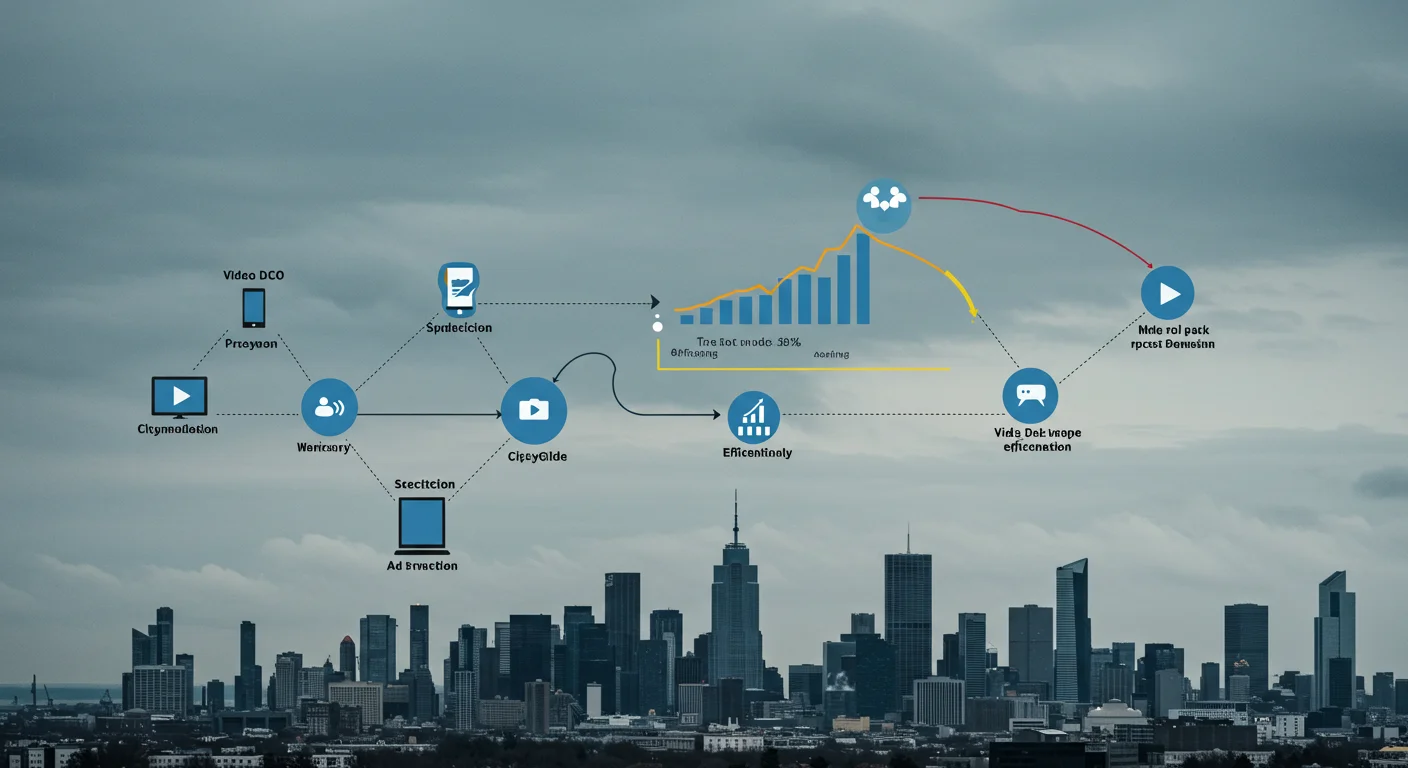
This is where DCO shines, but it demands a different way of thinking about creative production. Instead of producing 10 distinct video ads, we produced components. We broke down our video narrative into:
- Opening Hooks: Scenes showcasing different user demographics (e.g., young professional, student, tourist).
- Problem/Solution Scenarios: Clips illustrating common urban pain points (e.g., traffic jams, parking woes) and how CityGlide solves them.
- Location Overlays: Footage filmed in specific Atlanta neighborhoods (e.g., Midtown, Old Fourth Ward) and Charlotte areas (e.g., Uptown, South End).
- Call-to-Action (CTA) End Cards: Dynamic text overlays featuring different offers (e.g., “First Ride Free,” “50% Off Your First 30 Mins”) and app store icons.
- Music/Voiceover: Varied audio tracks to match different moods or target demographics.
We ended up with 5 opening hooks, 4 problem/solution scenarios, 6 location overlays (3 per city), 3 CTA variations, and 2 music tracks. This modularity allowed the DCO platform to assemble thousands of unique video combinations. We used Ad-Lib.io as our primary DCO platform, integrating it directly with Meta Advantage+ creative and Google Ads Performance Max campaigns.
Targeting and Data Integration
Our targeting strategy was multi-layered. We focused on:
- Geographic: Hyper-local targeting within a 2-mile radius of scooter hubs in both Atlanta and Charlotte.
- Demographic: Adults aged 21-45, with an emphasis on those living in apartments or condos.
- Behavioral: Interests in public transport, ride-sharing, fitness, sustainability, and urban living.
- Retargeting: Users who had visited the CityGlide website but not downloaded the app, or downloaded the app but not completed a ride.
The magic happened with our data integration. We connected our CRM, which contained anonymized user profiles and ride data, to the DCO platform. This allowed us to feed real-time signals. For instance, if a user frequently rode scooters near Piedmont Park in Atlanta, our DCO system would prioritize showing them a video ad featuring that specific park, even if their broader demographic profile might have suggested a different creative. This level of personalization is incredibly powerful.
“According to a 2025 study by MarketingOps, only 16% of RevOps professionals trust the accuracy of their data, and they identify it as the single biggest blocker to automation maturity.”
Campaign Performance: What Worked (and What Didn’t)
Here’s a breakdown of the campaign’s performance metrics, comparing the DCO video ads against a control group running static, non-personalized video creatives (which we ran for a baseline comparison in a separate, smaller test group).
| Metric | DCO Video Ads | Static Video Ads (Control) |
|---|---|---|
| Impressions | 14,500,000 | 3,200,000 |
| Unique Reach | 3,800,000 | 1,100,000 |
| CTR | 2.1% | 1.2% |
| App Installs | 32,000 | 4,500 |
| CPI (Cost Per Install) | $1.87 | $3.60 |
| First-Ride Conversions | 18,500 | 2,100 |
| Cost Per Conversion | $6.48 | $15.24 |
| ROAS (First Ride) | 2.4x | 0.9x |
What Worked Incredibly Well
- Hyper-Local Creative Matching: The most significant win was the performance of location-specific overlays. Videos showing scooters being ridden in specific Atlanta neighborhoods like Virginia-Highland or Charlotte’s Plaza Midwood saw CTRs up to 2.8%, significantly outperforming generic cityscapes. I mean, it makes sense, right? People connect with what they know.
- Problem/Solution Synergy: Pairing the “stuck in traffic” opening hook with a “scooter freedom” solution scenario yielded a 35% higher conversion rate than other combinations. This validated our initial hypothesis about addressing specific pain points.
- Dynamic CTA Offers: We initially tested “First Ride Free” versus “50% Off Your First 30 Mins.” The DCO platform quickly identified that “First Ride Free” resonated better with new users, leading to a 15% higher app install rate. We then dynamically shifted budget towards this winning CTA.
What Didn’t Work as Expected
- Demographic Stereotyping: We had some initial assumptions about which “look” (e.g., business casual vs. athletic wear) would appeal to which demographic. Interestingly, the DCO platform revealed that these assumptions were often incorrect. A “young professional” demographic sometimes responded better to the “student” aesthetic in certain contexts. This highlights the importance of letting the data guide creative choices, rather than relying solely on intuition.
- Overly Complex Combinations: While DCO allows for thousands of combinations, we found that some overly complex video edits (rapid scene changes, multiple text overlays) actually reduced engagement. Simplicity, even within personalization, proved to be key for clear messaging.
Optimization Steps Taken
Throughout the campaign, we continuously monitored performance and made adjustments. My team and I reviewed the DCO platform’s insights daily. For instance, after the first week, we noticed that videos featuring solo riders were outperforming those with groups. We swiftly de-emphasized group footage in our dynamic assembly rules. We also refined our audience segments, splitting the “young professional” group into “commuters” and “leisure riders” based on inferred travel patterns from our CRM data. This allowed for even finer-tuned creative delivery. We also allocated 70% of our budget to Meta platforms and 30% to Google Ads, as Meta delivered a lower CPI for app installs in this specific campaign.
One anecdote I often share: we had a client last year who was convinced that a specific, high-production-value video would be their “hero” creative. They insisted it run unedited. When we put it head-to-head with DCO-assembled variants, the dynamic creatives, though individually less polished, consistently outperformed the hero video by significant margins. It’s a powerful lesson in humility and data-driven creative.
The Power of Dynamic Creative Optimization
The results speak for themselves. Our DCO video campaign for CityGlide Scooters delivered a CPI that was 48% lower than the static control group, and a ROAS that was 167% higher. This isn’t just a marginal improvement; it’s a fundamental shift in campaign effectiveness. The ability to programmatically assemble and deliver truly relevant video content to individual users at scale is, in my opinion, the future of digital advertising. It’s not just about efficiency; it’s about building a stronger, more personal connection with your audience. Sure, it requires more upfront planning and asset creation, but the long-term gains in performance and audience engagement are undeniable. Don’t fall into the trap of thinking one perfect video will win the day. Think modular, think data, think DCO.
Embracing dynamic creative for your video ads means moving beyond static content and truly engaging with your audience on an individual level. It’s about letting the data tell you what your customers want to see, not what you think they want to see, and then giving it to them, instantly.
What is dynamic creative optimization (DCO) for video ads?
Dynamic Creative Optimization for video ads is a technology and strategy that automatically assembles personalized video advertisements in real-time. It uses a library of modular video assets (e.g., different intros, product shots, CTAs, backgrounds) and combines them based on user data, such as demographics, location, browsing behavior, and time of day, to create the most relevant ad for each individual viewer.
How does DCO improve video ad performance?
DCO improves video ad performance by increasing relevance. When an ad feels tailor-made for a specific viewer, it captures attention more effectively, leading to higher click-through rates, better engagement, and ultimately, more conversions at a lower cost. It eliminates the guesswork of A/B testing static ads by continuously testing and optimizing combinations on the fly.
What kind of assets do I need to create for a DCO video campaign?
For a DCO video campaign, you’ll need to produce individual, modular video components rather than complete, linear videos. This includes various opening hooks, product shots, background scenes (potentially location-specific), talent showcasing different demographics, problem/solution scenarios, text overlays, call-to-action end cards, and different audio tracks or voiceovers. Each piece should be designed to be interchangeable.
Is DCO only for large budgets or complex campaigns?
While DCO can certainly handle complex campaigns and large budgets, its benefits are accessible to a wider range of advertisers. Many ad platforms, including Meta and Google, offer integrated DCO features that can be activated with a well-planned set of creative assets, even for moderate budgets. The key is the modular approach to creative, not necessarily an enormous budget.
What are the main challenges when implementing DCO for video?
The primary challenges include the upfront effort required for modular video asset creation, ensuring seamless integration between your data sources (CRM, website analytics) and the DCO platform, and the need for continuous monitoring and refinement of the dynamic rules. It also requires a mindset shift from producing fixed creative to managing an evolving library of components.


