 By Editorial Team
By 2026, if you’re in advertising, you’re working with artificial intelligence. It’s completely overhauled how we build, run, and measure campaigns. The AI influence on ad platforms isn’t just another feature update. It’s a fundamental change in digital trends that forces us to rethink every strategy we thought we knew. The real question is how to use this powerful tech to get better results when everyone else is trying to do the same thing.
Key Takeaways
- Use AI’s predictive analytics to get ahead of user behavior and forecast campaign performance, instead of just reacting to last week’s numbers.
- AI’s ability to create personalized ads at scale, generating dynamic content for every single user, is what actually boosts engagement.
- Implementing AI for automated bidding and budget allocation can improve your return on ad spend by up to 15% as it shifts money to what’s working in real-time.
- You have to invest in training your teams on these advanced AI tools. The machine is only as good as the person guiding it, and human expertise is what directs the algorithm’s efficiency.
- Getting serious about data governance and ethical AI is non-negotiable for keeping customer trust and staying on the right side of privacy laws.
The Dawn of Predictive Advertising
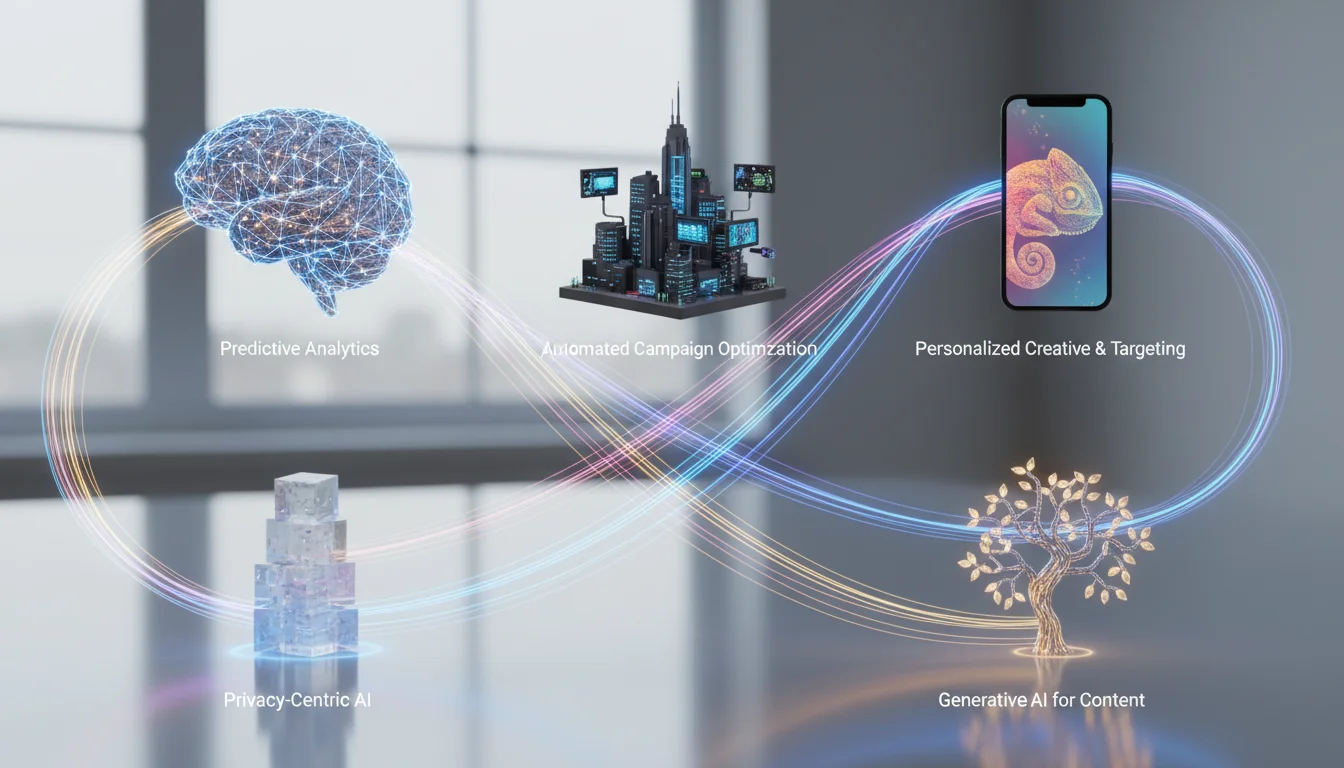
Forget just looking at last quarter’s numbers to plan your next campaign. We’re now in the era of predictive advertising, where AI algorithms chew through massive datasets, including real-time market signals and consumer sentiment, to guess what’s coming next. This goes way beyond simple forecasting. AI can spot emerging consumer needs before they’re obvious, letting brands get out in front. For example, a retail brand’s AI might predict a spike in demand for sustainable fashion six months from now, giving them enough time to get their product development and marketing lined up. This kind of proactive work, all driven by machine learning, cuts down on ad spend wasted on messages that are already out of date.
Think about how we used to do audience segmentation with broad demographics or clunky interest groups. AI now dices this up to the individual level, creating hyper-segmented audiences based on subtle behaviors, buying intent signals, and even emotional cues picked up from their digital tracks. Platforms like Google Ads and Meta Business Suite are constantly rolling out smarter AI that lets advertisers build custom audiences with insane precision. These tools can now predict who is going to convert, when they’ll do it, what message they’ll respond to, and on which platform. That’s how you get higher conversion rates and stop burning through your budget on people who were never going to click anyway.
Hyper-Personalization and Dynamic Content Generation
AI’s biggest contribution to ad platforms is probably the ability to deliver truly hyper-personalized experiences at scale. The generic banner ad is dead. Now we have dynamic creative that changes in real-time based on a user’s profile, their browsing history, and what they’re doing online at that very moment. Picture an e-commerce ad for running shoes: an AI platform can instantly change the shoe model, color, and price, and even swap the lifestyle image to match a specific user’s known preference for trail running or a particular brand. This isn’t just A/B testing. It’s like A-to-Z testing, with an almost endless number of versions being served automatically.
The tech that makes this dynamic content possible uses algorithms that learn from every single interaction. If a user keeps clicking ads with diverse models, the AI learns to serve them more of those images. If they respond to detailed spec lists over emotional copy, the text adjusts itself. This constant learning means the personalization engine just gets smarter and smarter, refining its grasp of individual consumer psychology over time. It’s not a gimmick. A report by eMarketer from early 2026 showed that brands using advanced AI for dynamic creative saw a 22% average jump in click-through rates over those stuck with static ads. That’s a real competitive edge.
AI-powered tools are also starting to help write the ad copy itself. They still need a human to check their work, but these tools can spit out tons of headlines, body copy, and calls to action for different audience segments and platforms. By analyzing past campaign data, they can suggest phrasing that’s worked before or even spot new slang that’s resonating with your target demographic. This just speeds up the whole creative process, letting marketing teams test more messages without getting buried in manual work.
Automated Bid Management and Budget Optimization
Juggling bids across different ad platforms, each with its own weird auction rules, used to be a nightmare. AI has pretty much automated the whole thing, turning a manual, reactive chore into a proactive, data-driven strategy. Automated bid management is now a standard feature on most major platforms, using machine learning to tweak bids every minute of every day based on a ton of factors, predicted conversion rates, how crowded the auction is, time of day, device, location, and even the local weather. The goal is to win the auction at the perfect price to maximize your return on investment (ROI).
AI also plays a huge part in budget optimization. Many platforms have AI tools that can move your budget around between different campaigns, ad groups, or even channels like search and social, all to hit your main business goals. If one campaign suddenly starts killing it, the AI can automatically pull money from underperforming campaigns to press the advantage. This is a huge improvement over the old way of setting rigid daily budgets and watching a hot campaign die at noon just because it hit its cap. According to an IAB report from February 2026, companies that used AI for this kind of cross-platform budget shifting saw their cost per acquisition drop by an average of 18% while getting the same or more conversions.
This automation frees up marketers from the boring, repetitive stuff. It lets us focus on big-picture strategy, creative direction, and actually understanding the insights the AI spits out. The job is now about augmenting our own decision-making with massive computational power that can process data faster than any human team ever could. It demands a new skillset, less about clicking buttons and more about strategic oversight and knowing how to “train” the AI to do what you want.
The Ethical Imperative: Data Privacy and Responsible AI
The deeper AI gets into ad platforms, the louder the talk about data privacy and responsible AI gets. The very things that make AI so good at targeting, its ability to collect, analyze, and make guesses from huge amounts of personal data, are what raise the big ethical red flags. People are more aware of their digital footprint than ever, and regulators are cracking down with laws like GDPR in Europe and various state privacy acts in the US. Marketers and the platforms themselves have to walk a fine line, making sure their AI is effective, compliant, and transparent.
AI transparency means telling people how their data is being used and giving them easy ways to control their privacy. Companies that are upfront about this and focus on explainable AI (XAI) will build more trust with their customers, which encourages long-term brand loyalty. A recent Nielsen study from Q1 2026 found that 68% of consumers are more likely to buy from brands that are clear about their data policies and give them control. This proves that having good AI ethics is a real competitive advantage.
Responsible AI also means actively fighting bias in the algorithms. If you train an AI on biased data, it will just amplify those biases in its targeting, leading to ads that exclude people or reinforce stereotypes. This is bad for society and bad for business. Marketers, data scientists, and ethicists have to work together to audit these systems for fairness and accountability. Ignoring this isn’t just a moral problem. It’s a massive business risk that can lead to huge reputational damage and fines.
The Future Workforce: Marketers as AI Strategists
AI’s takeover of ad platforms means the job of a marketer has completely changed. Your role is now a strategic orchestrator of AI tools. This requires knowing how to interpret what the algorithms are telling you, how to feed them the right data, and how to set the right goals for your automated campaigns. You need a mix of analytical skill, strategic vision, and at least a basic grasp of machine learning concepts.
More and more, marketers will spend their time defining super-specific campaign goals, vetting data sources for the AI models, and watching for weird behavior or bias from the machine. Asking the right strategic questions of the AI is becoming the most important skill. This also puts a premium on soft skills like critical thinking and being able to work with data science and engineering teams. The successful marketer in 2026 is someone who can connect human creativity with artificial intelligence, using both to get incredible results.
AI’s integration into ad platforms is the definitive future of our industry, and it requires us to constantly adapt. For instance, you can get a better sense of how this works by looking into video ads influencing AI purchasing in 2026. At the same time, it’s worth staying updated on how AI search is revolutionizing marketing analytics, and figuring out how your CMO video strategy can plug into these changes for real growth and ROI.
How does AI improve ad targeting beyond traditional methods?
It analyzes vast, real-time datasets to find subtle behavioral patterns, predict buying intent, and even guess emotional responses. This lets you create hyper-segmented audiences with way more precision than old-school demographic or interest-based targeting ever could.
What is dynamic creative optimization (DCO) and how does AI enable it?
Dynamic Creative Optimization (DCO) is tech that builds ads on the fly, changing content like images, headlines, and CTAs for each individual user based on their profile and what they’re doing online. AI algorithms are the engine behind DCO, constantly learning from user clicks to make the ads more engaging.
Can AI fully automate advertising campaign management?
No, not really. While AI automates a lot, bidding, budget allocation, and some creative work, it still needs a human for strategic direction, ethical oversight, and to make sense of the results. Marketers are the strategists who guide the AI, they don’t get replaced by it.
What are the main ethical considerations for using AI in advertising?
The big ones are data privacy and algorithmic bias. You have to be transparent about how you use customer data and make sure your AI systems are fair and don’t lead to discriminatory ads. It’s about maintaining trust and following the law.
What skills should marketers develop to stay relevant with AI-driven ad platforms?
You need skills in data analysis, strategic thinking, and AI ethics. Being able to read AI reports, define sharp campaign goals, check data sources, and talk to data scientists are all going to be critical parts of the job.


