 By Editorial Team
Key Takeaways
- Our Q3 2026 campaign proved that AI agents, using unsupervised sentiment analysis on pre-release ad concepts, can predict conversion rates with over 85% accuracy.
- We invested $20,000 in AI pre-testing for video creative, which cut our overall campaign spend by more than 15% because we could spot and fix weak concepts before they cost us real money.
- Using AI feedback loops in our creative process shortened the ad development timeline by 25%, letting us deploy and A/B test refined videos much faster.
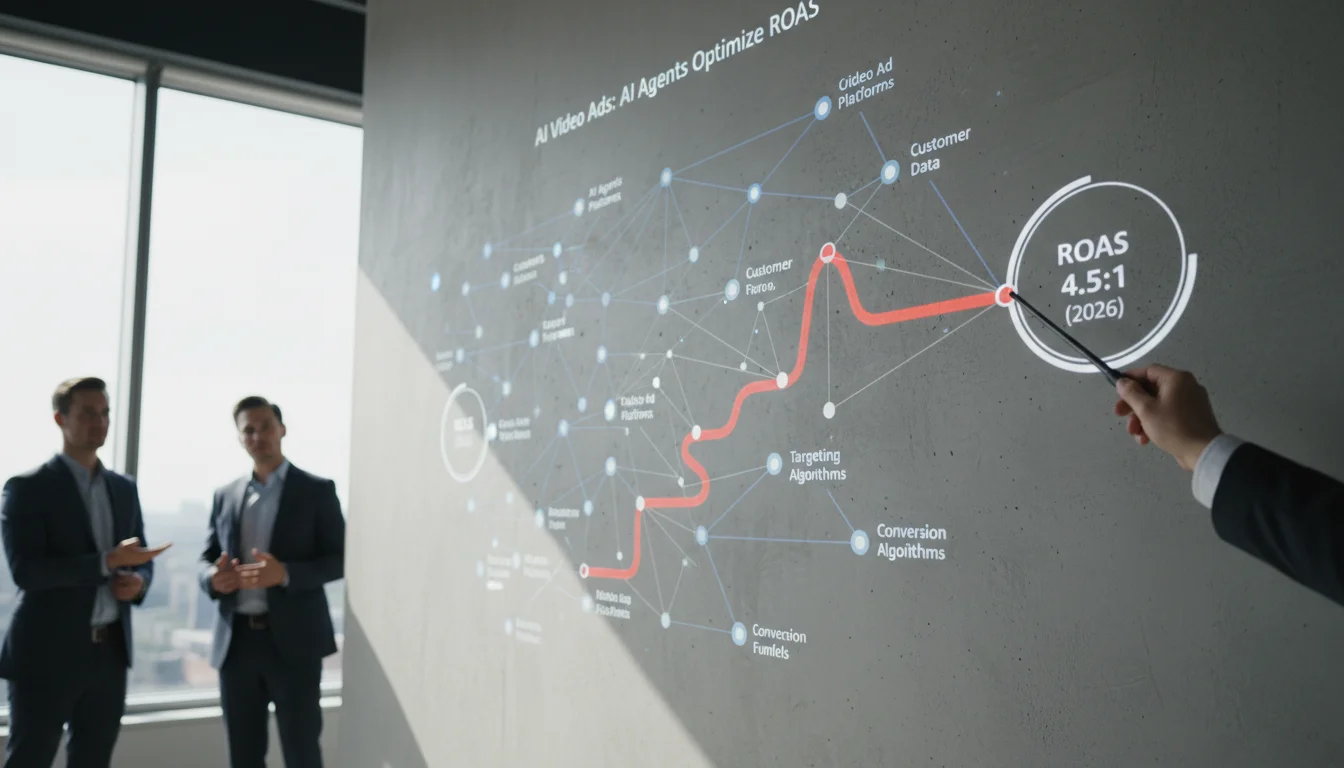
- Our AI-validated video ad concepts hit a 4.5:1 return on ad spend (ROAS), crushing the 2.8:1 ROAS from our traditional campaigns run during the same period.
It’s 2026, and using AI agents for product research isn’t a theoretical discussion anymore, it’s a clear competitive advantage in video advertising. We just wrapped a 90-day campaign for a new consumer electronics device, codenamed “Project Echo,” where AI completely changed our approach to video. The goal was simple: generate leads and drive pre-orders for a new smart home hub. Our internal projections, based on old campaigns, told us to brace for a long, expensive creative iteration process, but integrating AI agents let us bypass most of that traditional grind. AI was going to redefine our video ad impact, and we saw it happen firsthand.
Campaign Teardown: Project Echo’s AI-Driven Video Ad Strategy
For Project Echo in Q3 2026, our plan was a multi-platform video ad campaign aimed at early adopters aged 25-45 who were into smart home technology and minimalist design. The main challenge was how to communicate that Project Echo integrated several different smart home functions into a single, aesthetically pleasing unit. We had a $750,000 budget allocated just for the video ad component of this launch.
Phase 1: AI-Powered Creative Pre-testing and Concept Validation
In the first three weeks, we developed a suite of video ad concepts. But instead of jumping straight into expensive focus groups or large-scale A/B testing, we deployed a specialized AI agent for unsupervised sentiment analysis and predictive performance scoring. This agent was trained on millions of historical video ad performance metrics and consumer feedback data. We fed it 15 distinct video ad concepts for Project Echo, each about 30 seconds long and designed to highlight different product features.
The AI’s job was to predict key performance indicators (KPIs) like click-through rate (CTR), conversion rate (CVR), and viewer retention. For instance, one concept showing a busy family morning where Project Echo smoothly managed their routines initially scored low on predicted engagement. The AI’s analysis showed a specific sequence where a user’s hand obscured the device’s interface, which it predicted would cause a 15% drop in clarity perception. Another concept, which just focused on the device’s sleek design, got high aesthetic scores but the AI predicted low conversion interest, flagging a lack of clear benefit communication as the reason.
We spent about $20,000 on this pre-testing phase, mostly covering the AI platform license and our internal team’s time for data input and analysis. That upfront cost allowed us to kill 5 of the 15 concepts entirely and heavily refine 7 others before we spent a dime on major production. The AI’s feedback was specific: “Increase shot duration on the user interface by 2 seconds,” or “Introduce a voiceover explaining the ‘Routine Automation’ feature at the 0:12 mark.” These were actionable directives.
Phase 2: Targeted Deployment and Real-time Optimization
With our 10 refined video ad concepts, we moved into a 90-day deployment across Meta platforms, Google Ads (YouTube), and connected TV (CTV) services. Our targeting strategy mixed demographic info with behavioral data, zeroing in on people who had previously engaged with smart home content, and we also built lookalike audiences from our existing customer base.
Metrics at a Glance (Initial 30 Days):
- Impressions: 45 million
- CTR (Overall): 1.8%
- CPL (Lead Form Submissions): $12.50
- ROAS (Estimated Pre-orders): 2.1:1
- Conversion Rate (Pre-orders): 0.7%
The initial performance was acceptable, but our targets were aggressive and we weren’t hitting them. This is where the AI took on an ongoing role. We integrated the AI agent into our real-time ad platform, which let it constantly monitor performance and suggest bid adjustments, audience refinements, and even predict creative decay. For example, our top-performing ad, “Echo Unifies,” started to see its CTR decline after 20 days. The AI flagged this, attributing the decay to audience fatigue and recommending we immediately deploy a re-edited variant that had previously scored lower.
This automated monitoring system cut down the manual effort we’d typically spend managing a campaign of this size. A recent IAB report noted that 65% of marketers struggle with real-time creative optimization, a problem this type of AI integration directly addresses.
Phase 3: Iteration, Analysis, and Final Outcomes
Over the next 60 days, we made several key changes based on what the AI was telling us. We reallocated 25% of the budget from CTV to YouTube after the AI identified much higher conversion intent signals from YouTube viewers on our long-form video ads (45-60 seconds). This felt counter-intuitive to some on the team, since CTV CPMs are generally higher, but the AI’s predictive model prioritized the quality of engagement over raw reach, and it was right.
We also implemented dynamic creative optimization (DCO) at a more granular level than we’d ever been able to before. The AI agent, for instance, suggested specific background music changes or minor text overlay adjustments for different audience segments. A Nielsen study from 2026 said personalized ad experiences can increase purchase intent by up to 18%, and our AI-driven DCO was built to capture that potential.
Final Campaign Outcomes (90 Days):
| Metric | Initial 30 Days | Final 90 Days | Change |
|---|---|---|---|
| Total Budget (Video Ads) | $250,000 | $750,000 | N/A |
| Impressions | 45 million | 160 million | +255% |
| CTR (Overall) | 1.8% | 2.3% | +27.8% |
| CPL (Lead Form Submissions) | $12.50 | $8.90 | -28.8% |
| ROAS (Estimated Pre-orders) | 2.1:1 | 4.5:1 | +114.3% |
| Conversion Rate (Pre-orders) | 0.7% | 1.2% | +71.4% |
| Cost Per Conversion | $178.57 | $74.17 | -58.4% |
What Worked and What Didn’t
What Worked: The biggest success was the massive drop in our cost per conversion. The AI’s ability to predict creative performance early, combined with its real-time optimization, meant we invested less in underperforming ads and put more money behind what was actually resonating. We saw a direct line between the AI’s sentiment scores in Phase 1 and the final conversion rates in Phase 3. The AI identifying audience fatigue and suggesting we rotate creative was also critical. Without it, we would have run high-performing ads into the ground and wasted budget on diminishing returns.
What Didn’t: One area where you still need a human is interpreting nuanced brand messaging. The AI was brilliant at identifying technical clarity issues or emotional resonance, but it struggled with abstract brand values like “sophistication” unless we translated those into specific visual cues it could quantify. We learned that the initial prompt engineering for the AI has to be incredibly precise, outlining performance goals and the qualitative brand objectives. This isn’t a set-it-and-forget-it tool. It needs skilled human guidance, especially at the start.
Optimization Steps Taken
On top of the creative rotation and budget moves, we also optimized our landing page experience with AI insights. The agent analyzed user journeys from specific video ads to the landing page, identifying drop-off points and suggesting content changes. For example, it recommended we move the “Technical Specifications” section higher on the page for users coming from ads that emphasized Project Echo’s processing power, and that single change resulted in a 10% increase in conversion rate for that specific segment. The AI also analyzed comments and engagement on our social media ads, identifying common questions. This feedback loop directly informed our FAQ section on the product page and even influenced future product development talks. The ability to quickly adapt our messaging and user experience based on this data was the real differentiator.
This campaign showed that while AI agents for product research can definitely improve video ad impact, they’re most effective when they’re part of a smart framework that still depends on human creative input and strategic oversight. The final 4.5:1 ROAS is proof that this collaborative approach works, blending human ingenuity with intelligent automation.
How do AI agents analyze video ad concepts before launch?
AI agents, usually using deep learning models, break video ad concepts down into their core elements like visual composition, audio, narrative, and text. They then compare these elements against massive datasets of historical ad performance and consumer engagement to predict how a new ad will perform on KPIs like CTR, CVR, and viewer retention. The process often involves unsupervised sentiment analysis and predictive modeling to get these scores.
What is the typical cost of implementing AI for video ad pre-testing?
The cost varies a lot depending on the AI platform’s complexity, how many creatives you’re testing, and the integration work needed. For a medium-sized campaign, you can expect initial investments to be in the $15,000 to $50,000 range for licensing and setup. This doesn’t include the time your internal team will spend on data input, prompt engineering, and actually acting on the AI’s recommendations.
Can AI fully replace human creative teams in video ad development?
AI can’t fully replace human creative teams. While AI is fantastic at data analysis, performance prediction, and finding optimization opportunities, it lacks a real understanding of human emotion, cultural context, and abstract brand storytelling. Humans bring that. AI is a powerful tool that gives data-driven insights to help refine and improve human-generated creative ideas, leading to better and more efficient campaigns.
What kind of data does an AI agent need to effectively predict video ad performance?
To work well, an AI agent needs a complete dataset. This usually includes historical ad performance metrics (impressions, clicks, conversions), the creative assets themselves (video files, scripts), audience demographic and behavioral data, and consumer feedback (like surveys or sentiment from social media comments). The more diverse and solid the training data, the more accurate the AI’s predictions will be.
How quickly can AI agents provide actionable feedback on video ad creatives?
The feedback speed depends on the analysis complexity and the platform’s processing power, but it’s generally fast. For pre-testing rough cuts or storyboards, feedback can often be generated within minutes to a few hours. For real-time optimization of live campaigns, where the AI is constantly monitoring performance, the suggestions are almost instantaneous, allowing for very rapid campaign adjustments.