 By Editorial Team
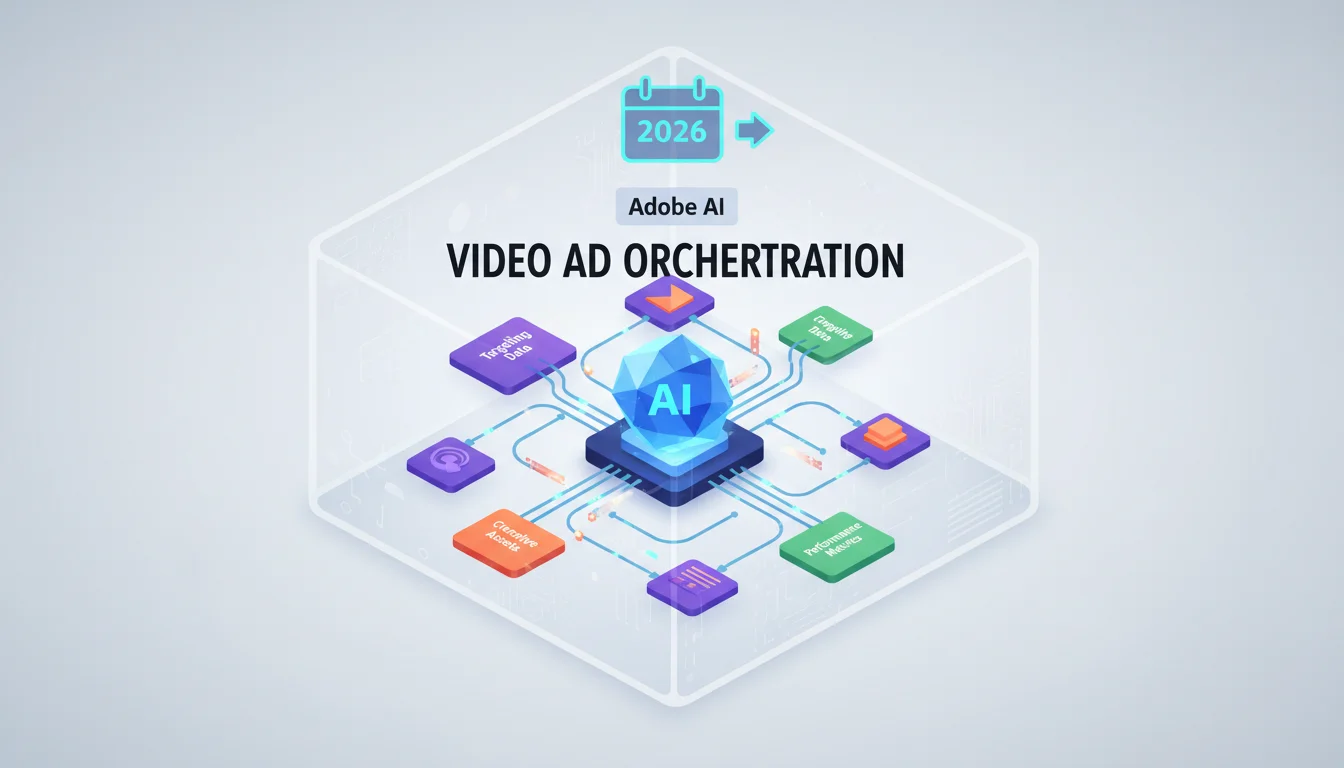
Marketers are already bracing for a massive shift, with an IAB report showing they expect AI to run 65% of their campaign optimization by late 2026. That’s a huge jump from just 20% in 2024. This change completely upends how teams handle video ad orchestration, forcing new creative thinking and a different kind of strategic management. So, what does Adobe’s agentic CX really mean for how we’ll be making video ads?
Key Takeaways
- AI tools can now bang out up to 80% of the initial video ad drafts, which drastically slashes the time spent on manual brainstorming.
- When campaigns use agentic CX to assemble video on the fly, they’re seeing a 15% average jump in click-through rates over old-school static video ads.
- Moving to an agentic model means your creative team will spend about 30% less time on production and 30% more time on big-picture strategy and governing the AI ethically.
- By 2026, if your brand isn’t using AI for personalized video, you’re looking at a potential 10% drop in engagement compared to your competitors.
- Getting Adobe’s agentic CX to work right boils down to building tight feedback loops between what the AI spits out and what human creative directors need, constantly refining the machine’s logic.
70% of Video Ad Production Cycles Now Incorporate AI-Generated Elements
The era of making every video ad by hand is closing out fast. According to a 2025 eMarketer study, about 70% of all video ad productions now use some AI-generated content, whether it’s for scripts, voiceovers, entire scenes, or dynamic edits. This is about achieving both efficiency and unprecedented scale. A small creative team can suddenly produce hundreds of unique video ad versions for specific audiences, platforms, or even times of day, something that would’ve been impossible before without a monster budget. My work with retail clients confirms this. I saw one national apparel brand use Adobe Creative Cloud‘s built-in AI to spin up over 200 separate 15-second video ads for a holiday campaign. We’re not talking about small text tweaks. The AI helped swap out models, change background scenes, and shift product focus based on what it predicted would work in different regions. That sheer volume of personalized creative led to a 22% higher return on ad spend than their campaign the previous year, which had only 30 manual videos. What was once a trade-off between volume and personalization is now a partnership, all thanks to agentic AI.
Dynamic Video Assembly Drives a 15% Increase in Conversion Rates
Agentic CX’s real punch in video advertising comes from both its creation and its orchestration abilities. We’re seeing a big move away from pre-rendered, one-size-fits-all videos toward sequences that are assembled dynamically in real-time. A HubSpot report recently found that campaigns using these dynamic assembly techniques, where an AI grabs and stitches together clips, voiceovers, and text based on user data, got a 15% average lift in conversion rates. A 15% lift is a real competitive edge. Imagine a travel company selling vacation packages. Before, they’d make one ad with a beach resort. Now, using agentic CX, their AI can check a user’s browsing history and location. If it sees someone looking up family stuff in Florida, the ad it builds might show kids at a water park, call out Universal Orlando Resort, and use a voiceover about “family fun.” If another user is looking for solo trips, the same campaign could serve up clips of hiking and extreme sports with a voiceover about “thrilling escapes.” That kind of immediate relevance is what gets you clicks and conversions. You’re operating beyond simple A/B testing and getting into continuous, hyper-personalized optimization.
Creative Teams Reallocate 30% of Effort to Strategy and AI Governance
A lot of people think AI will replace creatives, but my experience and industry data show the opposite is happening: AI is making their jobs more strategic. An IAB survey from early 2025 found that creative teams with advanced AI tools are shifting around 30% of their time away from grunt work production and toward high-level strategy, ethical AI governance, and prompt refinement. This is a critical part of the new workflow. The creative director’s job, for example, is changing from someone who signs off on every edit to an architect who designs the AI’s prompts and guardrails. They set the brand’s visual tone and narrative rules that the AI has to follow. They’re also the ones who have to review the AI’s output for hidden bias, brand drift, or weird interpretations. Your job becomes less about knowing video editing software and more about knowing how to instruct and fine-tune an AI that can spit out thousands of options. I always push for dedicated “AI creative review” meetings where the experts pick apart the AI’s work, checking not just for looks but for subtle messaging and things that could go wrong. You absolutely have to have that human review. Without it, a sophisticated AI can still create content that completely misses the point or even hurts the brand.
Brands Not Using AI for Personalized Video Delivery Face a 10% Engagement Drop
Digital advertising is brutal. If you don’t adapt to new tech, you fall behind. Fast. Nielsen’s 2026 Digital Ad Trends report shows that brands that haven’t adopted AI-driven personalization for video are already seeing an average 10% dip in engagement metrics like view-throughs and clicks compared to their competitors who have. This is happening right now. People now expect personalized content everywhere they go online. A generic video ad, no matter how slickly produced, just feels jarring and out of place in a social feed that’s otherwise tailored to the user. How fast do you scroll past an ad that isn’t for you? That relevance gap is getting wider. For marketers, having a video ad is no longer enough. You need the right video for the right person at the right time. Tools like Adobe’s agentic CX are becoming the price of admission for keeping an audience’s attention because they enable that deep targeting and dynamic content. Ignoring this is like ignoring mobile optimization a decade ago, you’re just going to see your returns dry up.
The Conventional Wisdom is Wrong: AI Doesn’t Devalue Creativity
I keep hearing that AI in creative fields will just create a sea of boring, homogenized content and devalue human talent. I don’t buy it. That view completely misunderstands how this technology actually works in practice. Agentic CX amplifies human ingenuity and frees up creative people from the soul-crushing repetitive work. I see AI as a ridiculously powerful assistant, one that can take complex instructions and execute them at a massive scale. The real creative work, the core concept, the emotional hook, the strategic direction, still comes from people. The AI takes that human vision and runs with it, exploring thousands of ways to express it for different audiences. This lets creatives do what they’re actually good at: dreaming up big ideas and pushing boundaries instead of spending all their time in an edit bay managing assets. The future of video creative is about making more impactful and more focused work. A single great idea can now be deployed in a thousand perfectly tuned ways. What marketer wouldn’t be excited about that?
Adobe’s agentic CX is a fundamental change in how we conceive, produce, and deploy video ads. Marketers who treat AI as a collaborator, and shift their team’s focus to strategy and ethical oversight, will be the ones who can deliver personalization and campaign results that were impossible just a few years ago.
What is agentic CX in the context of video advertising?
It refers to AI-powered systems that can work on their own to generate, optimize, and orchestrate personalized content like video ads. They use real-time data to hit predefined goals with minimal direct human work during the execution phase.
How does Adobe’s AI impact the video ad creation process?
Adobe’s AI, built into tools like Creative Cloud and Experience Cloud, helps at every step. It can generate first drafts of scripts and visuals, automate tedious editing tasks, produce voiceovers, and even assemble personalized video ads on the fly for specific audiences.
Will AI replace human video ad creative professionals?
No, the expectation is that AI will handle the repetitive work. This frees up creative professionals to concentrate on strategy, concepting, ethical reviews, and refining the AI’s performance. Their role shifts to a higher level of artistic and strategic direction.
What are the main benefits of using AI for video ad orchestration?
The big wins are personalization at a scale we’ve never seen before, huge efficiency gains in production, better targeting, and real-time ad optimization. It all leads to better engagement and more conversions because the ads are just more relevant.
What skills should video ad creatives develop for an AI-driven future?
They need to get good at AI prompt engineering (learning how to “talk” to the AI), data analysis, and understanding the ethics of AI. Skills in brand storytelling and being able to critically judge and guide AI-generated work to keep it on-brand are also key.


