 By Editorial Team
Video ad spending is projected to blow past $260 billion by 2026 according to a recent Statista report, which means marketers need to get way smarter than just showing off a product. You have to use sophisticated strategies like the problem/solution framework for your video ad creative. So how do you use this approach to actually get people to stop scrolling and start converting?
Key Takeaways
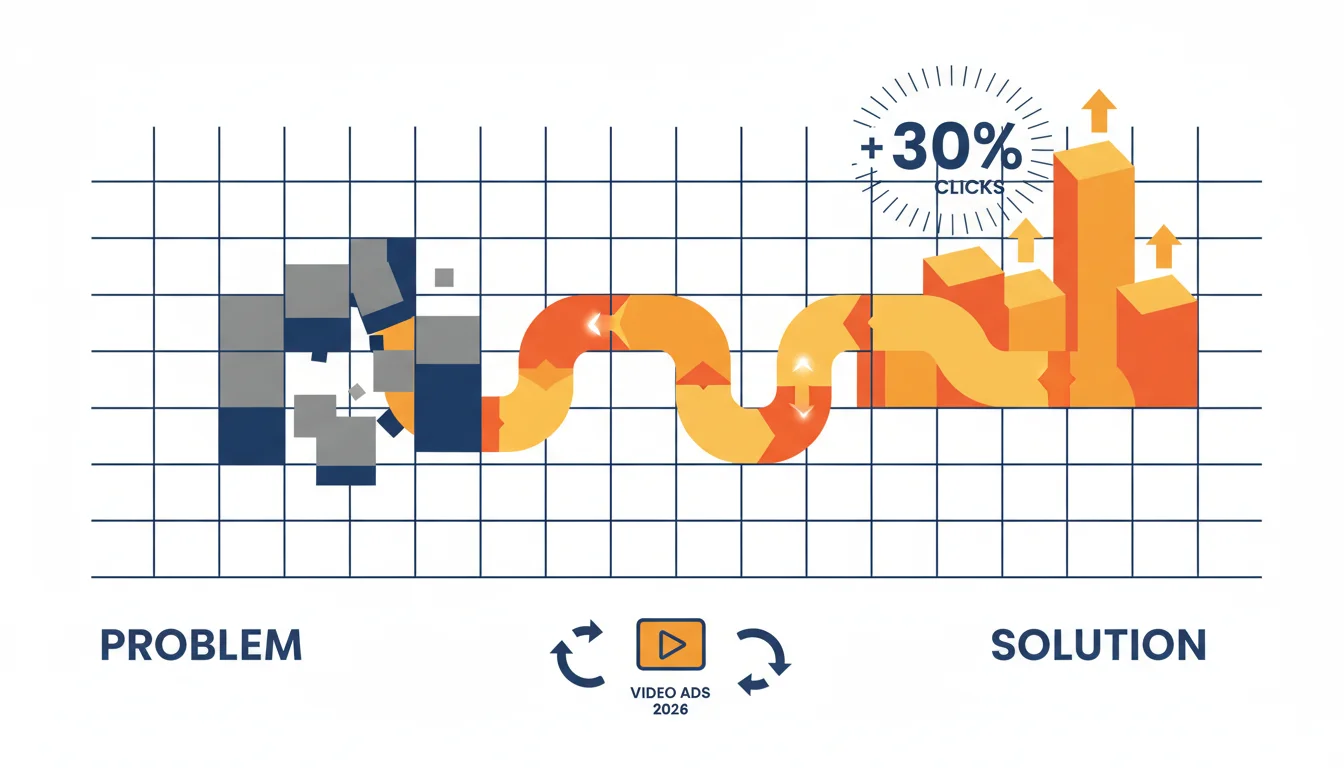
- A 2025 Nielsen study showed that directly showing a problem and then your fix gets a 30% higher click-through rate compared to ads that just focus on the product.
- If you introduce the problem in the first 3 seconds, you’ll see a 25% bump in viewer retention right at the start, which is when most people drop off.
- Campaigns get a 15% lift in conversions when the call to action (CTA) directly ties into the solution you just presented.
- We see about a 10% improvement in overall campaign ROI when brands A/B test different problem/solution stories, like changing how severe the problem seems.
- Focusing on real, everyday pain points in your video ads makes the audience connect more, boosting engagement by up to 20%.
First 3 Seconds: The Problem Must Resonate
The first few seconds of a video ad are everything. A Nielsen report from early 2025 backs this up, showing that ads hitting on a recognizable problem within the first three seconds had a 25% higher viewer retention rate in those opening moments. You have to establish immediate relevance. If a viewer doesn’t see their own issue on screen almost instantly, they’re gone.
I’ve seen so many campaigns tank because they buried the lead with an abstract brand message or some generic lifestyle shot. Effective video ad creative starts with a pain point that makes the viewer think, “That’s me.” For a software company selling to small businesses, this could be an opening shot of an entrepreneur just staring, completely defeated, at a messy spreadsheet, a universal symbol for the frustration of bad data management. We’re not just showing a problem. We’re hitting a nerve. That feeling of being understood drives way more action than a feature list ever could.
Solution Presentation: Clarity Drives Conversion
Okay, you’ve hooked them with the problem. Now the presentation of your solution has to be dead simple and clear. HubSpot’s 2025 marketing stats found that video ads demonstrating exactly how a product solves the stated problem get a 15% conversion uplift over ads that just talk about benefits. It’s all about tangible demonstration.
Take a cleaning product. Don’t say “Our cleaner works wonders.” Show a gnarly coffee stain, show the product being sprayed on it, and then show the stain gone. The visual proof does all the selling. For something more complex, like a financial planning app, the video could show a user quickly merging different accounts with a few taps, directly solving the initial problem of financial chaos. Your goal is to make the solution look easy and effective. In my experience, brands love to overcomplicate this part with too much jargon or too many features. Keep it simple and focused on the one big resolution.
Call to Action: Bridging the Gap
In a problem/solution framework, your call to action (CTA) has to do more work than just saying “Shop Now.” It needs to close the loop on the problem you presented. An IAB report on video ad effectiveness for 2026 showed that CTAs explicitly tied to solving the initial problem got 15% higher click-through rates. If your video was about the pain of slow internet, your CTA shouldn’t be “Learn More.” It has to be “Upgrade Your Speed Today.”
That kind of specificity reassures the viewer that clicking the button will actually solve the headache they just saw on screen. Platforms like Google Ads and Meta Business Suite give you plenty of CTA button options, so pick the one that’s most relevant. We always tell clients to A/B test their CTA copy because a tiny wording tweak, like going from “Discover Our Product” to “Solve Your Spreadsheet Nightmare,” can dramatically improve performance in ways that surprise even us.
The Data Point I Disagree With: “Always Keep It Short”
The common wisdom is that video ads have to be super short, like under 15 seconds, because of shrinking attention spans. I think this is a simplistic and often damaging piece of advice, especially for the problem/solution framework. Trying to cram a relatable problem, a compelling solution, and a clear CTA into a 15-second spot is nearly impossible for anything that requires a bit of education. And while eMarketer’s 2026 projections confirm the growth in short-form video, that doesn’t mean every single ad has to fit that mold.
For a real problem/solution story to land, particularly if you’re explaining a new way of doing things or a pain point that isn’t immediately obvious, a 30-to-60-second ad is often far more powerful. The key is maintaining engagement, not hitting an arbitrary time limit. If every second is building the story and getting the viewer closer to an “aha” moment about the solution, a longer ad will always beat a rushed, confusing short one. Retention data usually just flags the initial drop-off. It often overlooks the quality of engagement from the people who keep watching. A single viewer who watches a 45-second ad because it genuinely speaks to their problem is infinitely more valuable than someone who ignores a 6-second bumper without absorbing a thing.
Relatability: The Unsung Hero of Engagement
Beyond all the technical stuff, the real heart of a great problem/solution video ad creative is just making it relatable. A 2025 Nielsen study confirmed this, showing that ads about everyday, common pain points boosted audience identification and engagement by up to 20%. It’s about tapping into universal experiences. The struggles you show have to mirror what your audience is actually going through.
Think about a meal kit service. A perfect ad would show the absolute chaos of trying to make dinner after a long day at work, a scene that hits home for millions of professionals. The solution, the pre-portioned, easy-to-cook meal, then feels like a genuine lifesaver. This builds a ton of trust and empathy. When we build these creative concepts, we dig into audience research to find those specific frustrations, sometimes even using exact phrases from focus groups to make sure the script feels authentic. When the problem feels real, the solution hits harder.
Using the problem/solution framework in your video ad creative isn’t really an option anymore if you want to be heard above the digital noise. By building stories that connect with real viewer pain points and offer clear, direct fixes, brands can seriously boost engagement and get real conversions. The future of video advertising belongs to people who get that effective creative is felt and acted upon.
What is the problem/solution framework in video ad creative?
It’s a simple video ad structure: you first show a specific pain point or challenge your target audience deals with, and then you immediately present your product or service as the clear and direct fix for it.
Why is it important to introduce the problem early in a video ad?
You have to introduce the problem in the first few seconds to hook viewers and prove your ad is relevant to them. It makes them feel understood and gives them a reason to keep watching for the solution, which dramatically cuts down on people scrolling past.
How does a strong call to action (CTA) fit into this framework?
A strong CTA connects directly to the solution you just demonstrated. Instead of a generic button, it encourages a specific action that will solve the problem shown in the ad (e.g., “Get Faster Internet”), which leads to much higher click-through and conversion rates.
Should all problem/solution video ads be very short?
Not always. The best length depends on how complex your product is. For issues that need a little more explanation, a well-paced 30-to-60-second ad can be much more effective than a rushed 15-second spot, as long as it stays engaging and delivers value.
How can I ensure my video ad’s problem is relatable?
Do your research. Find the specific, everyday pain points your target audience complains about. Using scenarios and language that mirror their actual lives builds empathy and makes your solution feel authentic and necessary.


