 By Editorial Team
The 2025 holiday season had just wrapped, and Sarah, the head of digital marketing for “Urban Threads,” a mid-sized e-commerce apparel brand, felt a familiar knot of anxiety. Record sales were great, but the path there was a mess, especially with their video ad performance. Every major platform, from TikTok for Business to Google Ads, seemed to be rolling out huge algorithm tweaks and killing features weekly, which turned their careful campaign plans into a constant scramble. The promised stability for holiday marketing was a fantasy, forcing her team into a reactive sprint just to maintain visibility and conversions. To thrive in this relentless flux, brands need to build true video ad agility.
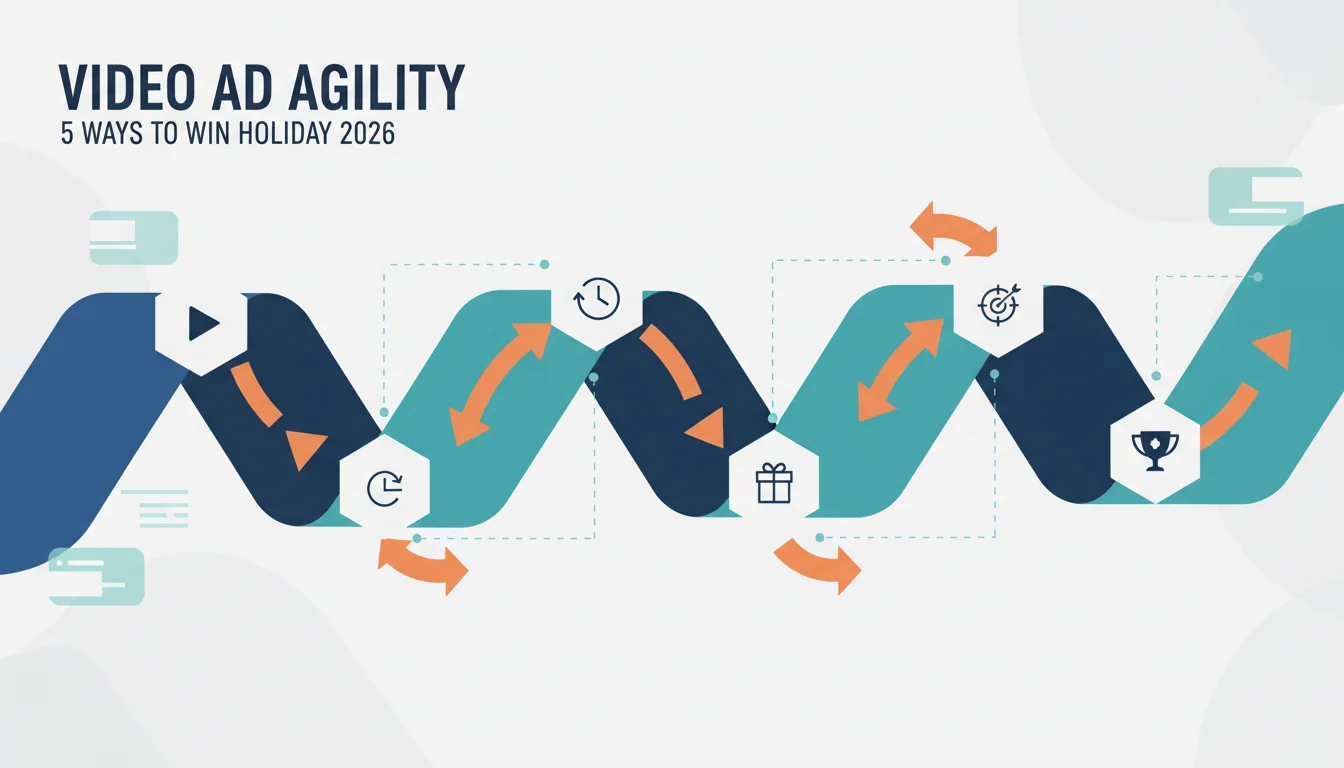
Key Takeaways
- Put together a dedicated “platform change” task force with clear roles for monitoring updates and getting creative adapted fast.
- Set aside at least 25% of your holiday video ad budget for experimental formats and new platform features to test new ground.
- Build a modular video asset library, which lets you quickly re-edit and repurpose core creative elements for diverse platform specs.
- Schedule weekly syncs between creative, media buying, and analytics teams to make sure communication is swift when platforms shift and performance changes.
- A/B test every new video ad deployment, running a minimum of three distinct creative variations per campaign to find what’s working right away.
Holiday Ad Platforms Are Changing
Sarah recalled one particularly frustrating Tuesday in early November. A seemingly minor update in Meta Business Suite completely altered how short-form vertical videos were prioritized in certain placements, suddenly favoring dynamic text overlays over traditional voiceovers. Urban Threads had invested heavily in a series of polished, voiceover-driven lifestyle ads. “It felt like pulling the rug out from under us,” Sarah recounted in their post-mortem. “Our engagement rates on Instagram Reels plummeted by 30% overnight for those specific creatives.” This wasn’t a one-off. Similar unannounced shifts hit YouTube’s Shorts algorithm and even Pinterest Ads, which began pushing more interactive video pin formats. The industry word, backed by the 2025 IAB Digital Video Ad Spend and Strategy Report, is that platform volatility is only going to get worse, making purely reactive strategies a losing proposition.
The timing of these updates is as much of a problem as the updates themselves. The holiday marketing window is unforgivingly short. A week of underperforming ads can translate into hundreds of thousands in lost revenue for a brand like Urban Threads. My own experience advising e-commerce clients confirms it: the brands that win during peak season are the ones with the fastest iteration cycles, not necessarily the biggest budgets. They treat platform changes as new parameters for creative problem-solving, not as roadblocks.
Building a Proactive Platform Watch Team
Sarah decided Urban Threads needed a dedicated system to anticipate and respond to these changes. Her first step was to formalize a “Platform Watch” subgroup within her marketing team. This wasn’t about adding headcount, but reallocating responsibilities. Maya, their most detail-oriented media buyer, was tasked with daily monitoring of official platform business blogs, developer forums, and industry news feeds. “We needed someone whose job was literally to read the fine print,” Sarah explained. Maya set up specific alerts for keywords like “algorithm update,” “ad format change,” and “deprecation notice” across Google, Meta, TikTok, and Snap communication channels. This proactive intelligence gathering is everything. Waiting for performance to drop before you realize something changed is a losing game.
For instance, in mid-2025, Snapchat for Business quietly rolled out an expanded suite of AR lenses for ad creatives, allowing for more immersive product try-on experiences. Maya caught the announcement early. While many brands waited for case studies to emerge, Urban Threads quickly briefed their creative agency to develop two new AR-enabled video ads featuring their best-selling winter coats. They launched these ads within two weeks of the announcement, capturing an early adopter advantage. This quick pivot resulted in a 15% higher click-through rate on Snapchat compared to their traditional video ads during that period, according to their internal analytics.
The Modular Creative Strategy for Agility
The biggest bottleneck Sarah identified was creative production. Producing high-quality video ads simply takes time. When a platform update demanded a new aspect ratio or a different call-to-action overlay, their agency often needed days, sometimes weeks, to deliver revised assets. That lag was unacceptable during the holidays. Her solution: a modular creative strategy.
Instead of single, monolithic video ads, Urban Threads began breaking down their video content into core components: a product shot library, diverse talent footage, interchangeable text overlays, multiple music tracks, and various CTA animations. “We started thinking of our video ads like LEGO bricks,” Sarah mused. “If TikTok suddenly favored shorter, text-heavy intros, we could swap out our 5-second brand intro for a dynamic text card from our modular library in hours, not days.” They invested in cloud-based collaborative editing software that allowed their internal team to quickly assemble and render new versions using pre-approved assets. This significantly reduced reliance on external agencies for minor tweaks, freeing them up for more conceptual work.
One memorable instance involved a last-minute change on YouTube around Black Friday, when its algorithm began heavily favoring videos with embedded, interactive product feeds in certain in-stream ad formats. Urban Threads had existing product photography and video clips. By using their modular approach, their internal team was able to integrate these interactive elements into their existing holiday video ads within 24 hours. The result was a 10% increase in direct product page visits from those specific YouTube campaigns, a direct outcome of their ability to adapt so quickly.
Rapid A/B Testing and Performance Validation
Agility means changing effectively, not just fast. Sarah instituted a rigorous A/B testing protocol for all new or adapted video ads. “We stopped guessing what the platforms wanted,” she stated. “Instead, we tested.” For every major campaign, they would launch at least three distinct video variations tailored to the latest platform insights. For example, after the Meta Reels update, they tested: one video with prominent dynamic text, one with minimal text and a strong visual hook, and one with a traditional voiceover but a much faster pacing. They ran these tests with small, controlled budgets for 48 hours, closely monitoring key metrics like view-through rate, click-through rate, and conversion rate. The winning creative would then receive the bulk of the ad spend.
This rapid testing culture encouraged experimentation. One key insight they gained was that while platforms might push certain features, audience preference still dictated success. For example, Pinterest’s push for interactive video pins didn’t always translate to higher conversions for Urban Threads’ specific audience, who often preferred visually rich, aspirational static images for clothing discovery. They learned that you have to test new platform features, but blindly adopting them without validating performance is a waste of resources. This empirical approach, driven by data from their Google Analytics 4 dashboards, allowed them to maintain efficiency even amidst constant change.
The Future: Continuous Adaptation
By the time the 2026 holiday season planning began, Urban Threads was a different company. Sarah’s team had internalized the concept of video ad agility. Their “Platform Watch” subgroup was now a permanent fixture providing weekly intelligence briefings. The modular creative library was constantly updated, and their internal team was proficient in rapid asset assembly. A/B testing was an integrated first step in every campaign launch. “We’ve stopped fighting the current,” Sarah concluded. “Now, we’re learning to surf.” The lesson is that platform changes are opportunities to be seized by those prepared to adapt with speed and intelligence. The future of digital advertising, especially during high-stakes periods like the holidays, belongs to the agile.
Brands have to cultivate a culture of constant learning and rapid iteration, building teams and processes that can pivot on a dime. This means investing in tools for quick creative iteration, fostering a data-driven testing mindset, and having dedicated team members stay ahead of platform announcements. The next holiday season will bring new challenges, but Urban Threads is now equipped to thrive within that dynamic environment.
What does “video ad agility” mean in holiday marketing?
It’s a brand’s ability to rapidly adapt its video advertising creative, targeting, and strategy in response to real-time changes in advertising platform algorithms, features, and audience behavior during peak shopping seasons. It involves quick iteration, testing, and deployment.
How can brands monitor platform updates effectively?
Effective monitoring means assigning a dedicated team member to regularly check official platform business blogs (e.g., Meta for Business, Google Ads Blog, TikTok for Business), subscribe to industry newsletters, and set up keyword alerts for terms like “algorithm change” or “ad format” to catch announcements early.
What is a modular creative strategy for video ads?
A modular creative strategy breaks down video ad components into interchangeable elements like product shots, talent footage, text overlays, and CTA animations. This allows marketers to quickly assemble new video variations to meet evolving platform requirements or test different creative approaches without starting from scratch.
Why is rapid A/B testing important for holiday video ads?
During the holidays, rapid A/B testing lets you quickly identify which video ad creatives perform best under current platform conditions. This minimizes wasted ad spend on underperforming assets and lets you swiftly allocate budget towards winning variations, maximizing ROI during a critical sales period.
What specific tools can help with video ad agility?
Tools that help with video ad agility include cloud-based collaborative video editing platforms (like Adobe Premiere Pro or DaVinci Resolve with shared projects), dynamic creative optimization (DCO) platforms, and strong analytics dashboards (like Google Analytics 4) for real-time performance monitoring.


